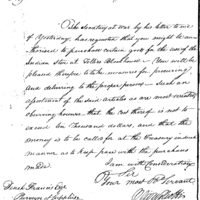
Informs Keteltas that the claims he purchased from soldiers of the New York Line regiments are foreclosed from settlement by Acts of Limitation passed by Congress.
Notification that he will receive the money for the pay of the Army troops in Georgia from Daniel Stevens, federal supervisor at Charleston, South Carolina.
Hodgdon is asked to direct Mr. Harris to forward the following articles to the men of the Corps of Artillerists and Engineers at Governors Island near New York: pairs of woolen overalls, pairs of socks, and pairs of shoes (large sizes). Since their detachments are under orders for Norfolk and Charleston these articles should be forwarded immediately via [?] and South Amboy.
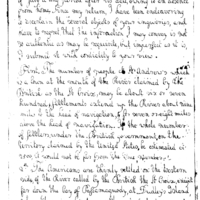
Knox describes British and American settlement of St. Andrews and St. Croix, New Brunswick. The climate is temperate--healthy and favorable to agriculture. Good potential for foreign and domestic commerce with fine bays and harbors and a good supply of fish. Commerce between British and Americans is not great. French privateers have captured many vessels. A custom house on one island mans officers who work to protect commerce. Discusses boundaries between Maine and Canada. Remembers French settlers during Revolutionary War. Refers to water transportation to Quebec.
Wilson finds himself astonished that he may have drawn his subsistence twice for the month of September. He assures Simmons that he will make a strict examination of his acount and rectify whatever mistake has been made.
Comments on the method of tracking expenditure estimates; mentions receiving instructions on this topic. Lists recent bills drawn; refers to expenditure estimate for October. Also discusses the sloop Detroit.
Instruction received. Notification that Wilkins is now drawing bills per estimate of expenditures for October, November, and December. Lists bills, amounts, and who they were drawn for. Enclosed list of articles traveling from New York to Presque Isle.
Among other matters, Langham notes that on his way to the western country at Cumberland he found a cache of public stores. They had been lodged there by return wagons from General Morgan's camp on the Monongahela and were in bad order. The stores were not ruined so he sent a wagon to retrieve them. Finding his brother, who went to Kentucky on business for him, dead, Langham realizes that he had not given himself enough time to complete any business in that country so he will be obliged to return.
Winchester refers to a case between McHenry and the state, but tells him they are loathe to do anything that diminishes their revenue. He refers to politics, and how they wait for news from a distance, at the price of those at home. He discusses the political fortunes of some gentlemen in the race.
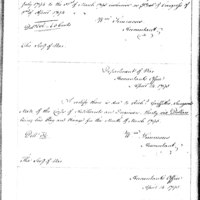
Simmons certifies that $16.06 is due Private John Killin of Captain William Purdy's late company of levies, being the balance of his pay per Abstract D. No. 108.
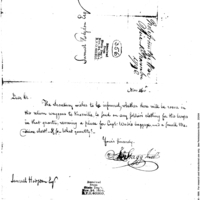
The Secretary of War wants to know whether there will be room in the return wagons to Knoxville for soldiers' clothing intended for the troops in that quarter while reserving space for Captain Wade's baggage and a small medicine chest. If so, what quantity of clothing would be allowed?
Articles of infantry clothing can be appropriated to make up the deficiency in artillery clothing in Colonel Rochefontaine's return if the buttons are changed. They are in the hands of the Contractor and should be ready soon. The other articles required are in the stores including: drums, wooden shells, brass shells, sets of heads, receipt books, and stationery.
John Cole and his three brothers (Tenn[-]Cole, Henry Cole, and Garrit Cole) paid. Kileltas requested information regarding sick pay for soldiers by next post.
William Polk noted allowance due Ensign Polk from his time spent recruiting, in captivity, and marching prior to his departure for the West Indies. Wm. Polk also included a deposition from Thomas LeFevre regarding pay advanced to enlisted men in Fayetteville by Ensign Polk. Wm Polk stated charges against Ensign Polk were not founded on law and he sought attention of Simmons to Polk's case.