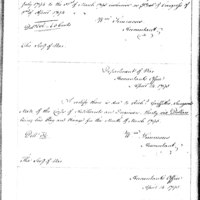
Notification to Simmons that he has paid Constant Freeman, agent of the War Department in Georgia, in accordance with Simmons directions. Cited in Simmons to Stevens 12/09/1796
Provides Willson with copies of his provision returns showing that he has drawn rations twice in one month by mistake and must apply the pay to a subsequent month
Simmons certifies that $177.54 is due the recruits under the command of Captain William Rickard at Tarborough, North Carolina, being their pay for September 1796.
Simmons certifies that $488.27 is due Ensign Larkin J. Dickinson and the recruits under the command of Captain Alexander Gibson, being his and their pay through October 1796.
Amidst a discussion of accounting matters, Swan declares his appoval for the new organization that discontinues double pay and forage for quartermasters and paymasters. Swan has for some time objected to this practice but knew it would be eliminated only by a premptory order.
Lieut. Robinson applied to Rochefontaine for an advance of money for the move of his family to Charleston, Robinson paid from personal purse. Men enlisted by Capt. Thompson applied for bounty due them which is yet to be received.
Garrison from West Point to arrive at Fort Norfolk, request for procurement of boat, clothes, and shoes. Saunders noted his pay was omitted from the letter to Mr. Triplett, therefore requested his pay from McHenry.
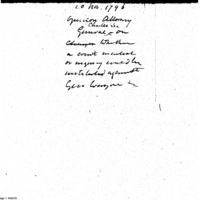
Attorney General Lee writes to McHenry regarding his opinion of a court martial for General Wayne, based on charges brought forth by General Wilkinson. He discusses that the President, as Commander in Chief of the army, has the right to order a court martial upon an inferior officer. It is also within his discretion to determine whether a court of enquiry shall be instituted previous to his court martial. The court of enquiry may be ordered without the consent of the accused. The President may also take command of the army from General Wayne, and commit it to another. The accused may also request a court of enquiry. The court shall proceed according to the 25th, 26th, and 27th articles of war drafted in 1786, and when finished are to be transmitted to the president, who will then determine whether or not a court martial shall be ordered.
Notifies Lt. Col. Rochefontaine that allowances made to sergeants in the Corps at West Point as sergeants-major and quartermaster sergeants are not authorized. Cited in Rochefontaine to Simmons, 11/25/1796.
Simmons certifies that $804.38 is due Thomas Love, late Paymaster of the Kentucky Mounted Volunteers, being the balance of his accounts for payments to said volunteers and his compensation from June 1795 through May 1796.
"Such of the articles as are now in store, and which have been purchased by the direction of the Secretary of State for the Algerians, you will be pleased to deliver to the Purveyor."
Passage to St. Marys should be arranged for Doctor McCrea which will be funded by the public. However, he will have to pay for the necessary supplies for the voyage himself.
Mr. Harris should be directed to forward as many papers as will be necessary to make fifty paper cartridges, each of which will hold sixteen pounds of cannon powder. The paper should be made up into cartridges of the size specified by Mr. [?] and delivered to him.
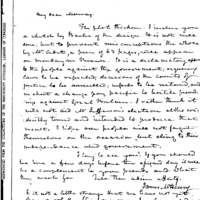
McHenry ruminates on a declamatory appeal to the people against the government arguing that laws should be repealed, court decisions should be annulled; vessels should be restored and a general change in policy from pacific to hostile should be purused toward Great Britain He believes it was intended to aid in Jefferson's election but doubts that it will do so.
Major Craig reports a post office blunder to Samuel Hodgdon. Craig also requests funds and hospital stores from Hodgdon. The popularity of the Democratic ticket in local elections is mentioned.