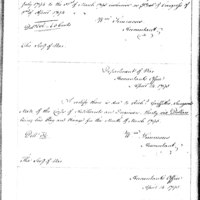
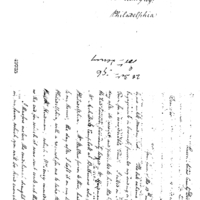
Simmons certifies that $49.33 is due Sergeant Philip Williams and the men under his command at Fort Johnston, North Carolina, being his and their pay for October and November 1796.
Simmons certifies that $85.96 is due Lieutenant William K. Blue, being his pay, subsistence, and forage, and the subsistence of his waiter, for October and November 1796.
Amidst a discussion of a number of supply matters, Houdin entreats Hodgdon to make his case before Congress for additional pay without which he will find it difficult to support himself. He also wants Hodgdon to forward his salary for the previoius three monthd of the current year.
The remittance from the Treasury has been received and the sum of $459.22 has been paid to Captain Michael Kalteisen at Fort Johnson. Stevens has also written to Constant Freeman in Georgia notifying him of the remittance for the pay and forage of the troops in that state.
Acknowledges receipt of receipts that will be credited on the books of the War Department accountants office. Discusses bounty and premium for enlisting a recruit, John Alexander.
Acknowledges receipt of receipt rolls. Acknowledges receipt of pay roll. Money for the pay will be forwarded by Nicholas Fish. Cited in Freeman to Simmons, 01/04/1797.
The Secretary of War prefers a military guard over the public storehouses rather than paying a Silent Watch sufficient to visit all the stores at every hour in the night. He wants to know the number of sentinals required for this service and wants arrangements made to put it into effect immediately.
James McHenry responds on behalf of the president, saying that he does not know if the boundaries described by the Choctaw chief are the same ones decided upon in the Treaty of Hopewell, but that he will consider them; that he will always endeavor to keep whites off the Indians' land, but that the garrisons in Choctaw country will still be manned, to achieve this enforcement; that U.S. trading posts in Choctaw country are legal, and will be constructed when the U.S. sees fit; that Benjamin Hawkins, Indian agent to the Creeks, will also be an intermediary for the Choctaws until another individual is appointed; says that presents for the whole of the Indian nation are unavailable because Congress has not appropriated the funds, but that personal presents for the Indian chiefs will be provided.
Refers to US treaty with Choctaw, alluding to boundaries determined by the chief's father. Refers to his desire to have Choctaw law respected by whites to protect land, which may happen when the Spanish leave the Natchez. Refers to requests made by his father to the Secretary of War involving other chiefs.
Even though Captains Jackson and Osborne have arrived with the iron and steel, there is no passing up the Connecticut River to Hartford. The best way to get it to Springfield is by way of New Haven and there are vessels bound for that place. Captain Osborne reports that he has not received his freight and asks that it be paid to him while in New York.
Cover for transmittal of receipts from Capt. Donald Mitchell, Lt. Nehemiah Freeman, Capt. Frederick Frye, Foreman Cheeseman, Colonel Rochefontaine, and Lt. Jonathan Robeson
Barry, Truxton and Humphreys list in detail the performance of the Burkes Patent Pumps they tested. It delivered 154 gallons of water in 35 seconds by 38 strokes of the brakes, and raised the water 12 feet with four hands. It was also able to bring up a quantity of walnut-sized stones as well as a four-pound shot. The pump is likely to be more reliable than the current chain pumps and will be easier to repair if they do break down. The three men strongly recommend that these pumps be installed in the frigates.
Acknowledges receipt of a receipt roll that will be credited on the books of the War Department accountants office. Discusses other pay issues for Frye's company.