Articles for the frigate building at Portsmouth have been ordered from the Purveyor. Wolcott has no notion of the qualifcations of Captain Thompson so McHenry should employ him as an agent based on his own assessment of his abilities.
Report on the state of the frigate "United States," now building in the port of Philadelphia. The frigate will likely be deployed to the Mediterranean to protect U.S. commerce against the hostile Algiers government and Barbary pirates.
Packet just received does not answer Hodgdon's requests. Hodgdon wants to know the quantity of stores, manner of consumption, and who consumed the stores. Information missing to complete receipts.
Cover letter with explanation for an abstract of an estimate received from David Henley, agent for the War Department in the South-Western Territory for payments made to militia for service under the U. S. government, including service in "Indian Country."
Settlement of accounts. The claim of Major Farragut presented by Congressman Jackson. A deed for land at location of a barracks. Mentions Indians being advanced money at his office. Account of Captain Chisholm for expenses of conducting Indians
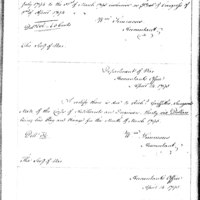
Simmons certifies that $14 is due to Joseph Cooper and George Carson of the Corps of Artillerists and Engineers, being their expenses from Philadelphia to Baltimore in pursuit of William Townshend, William Hines, and Bingham, deserters from said Corps.
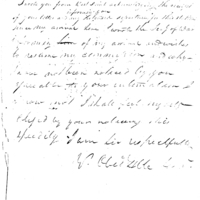
Duplicate letter including abstracts taken from the warrant books at the office of payments for Chisholm and other agents of Indian Department. Simmons questions some of the claims; disallows some, and asks that Henley pay strict attention to interests of United States in future settlement of accounts.
Summaries of warrants drawn by the Secretary of War on the Treasurer of the United States in September 1795 and December 1796. In favor of: Edward Carrington; John McKee; Captain John Wade; Captain John Chisholm; James Carey; Colonel John Watt, a Cherokee; Malcolm McGee; Colonel John McKee.
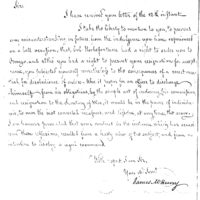
McHenry seeks to clarify the situation that Osborn created by attempting to resign his commission after Colonel Rochefontaine ordered him to Oswego. McHenry informs Osborne that Rochefontaine had the right to order Osborn to Oswego, and Osborn submitting his resignation does not relieve him of his duties. Thus, he would still be subject to the consequences of a court-martial. However, McHenry feels that Osborns actions were the result of a hasty view of the subject and not from the intent to deliberately disobey a direct command.
Notes that peace has faithfully been observed since a 1795 conference, though whites have killed Indians since then; expresses sorrow that these whites have not been punished. Describes the Indian-land boundary established Governor Blount [of TN], says he will abide only by that line. Asks that the boundary be formally run, by a U.S. surveyor of integrity (not a land speculator), and that Cherokee envoys be present at that process. Recommends when the boundary-running should take place.
Whipple discusses his efforts, at the direction of Mr. Wolcott, to restore to Mrs. Washington her escaped servant. He notes that many servants have escaped from the southward into Massachusetts which is injurious to many valuable estates in that region. For the good of society and individual interests, he wishes that some means be adopted of a public nature to prevent the growing contemplation of the abolition of this species of servitude (slavery).
Two accounts for contingent expenses enclosed, vouchers forwarded to Auditor of the Treasury. More vouchers to be forwarded to both Auditor and Simmons.
Letter, encloses statement of timber at Boston yard; discusses iron work for Frigate; discusses supply of live oak timber; mentions cannon for Frigates; mentions Thanksgiving; alludes to Republican party; alludes to Jeffersonians; asks for information re cannons for Frigate.
The letter informs Jones that Osborn wrote from West Point acknowledging Jones' previous letter and communicating Osborn's intend to depart for Governor's Island. Since his arrival there Osborn has written the Secretary of War informing him of Osborn's wish to resume his commission.
Josiah Fox offers Captain Thompson the position of superintendent at Portsmouth New Hampshire for $1300. If he accepts the terms, is to write to Secretary of War James McHenry.
Notification to Read that he will receive money that he is to transfer to Sergeant Phillip Williams of the Corps of Artillerists and Engineers for the pay of the men under his command at Fort Johnston.