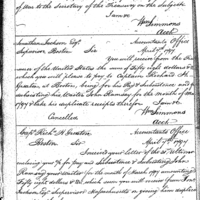
A number of receipts for bounty paid recruits inlisted by Boote received. Total amount: $127.00 to be examined on settlement of Boote's recruiting account.
Simmons notified Craig Lieutenant Charles Martin of 2nd Regiment is indebted to the United States $23.89, and Martin is ready to settle debt. Simmons requests Craig make immediate application to him for payment and on receiving grant and receipts forward records to Office.
Acknowledged letter by Martin containing receipt for bounty paid to Ebenezer Snow for $14.00. Amount mentioned plus $2.00 passed to the credit of Martin's account. Balance due to United States by Martin: $23.89, to be paid to Issac Craig in order to close Martin's account.
Notification by Simmons of receipt of letter regarding account of deGrasse. Total amount for quarter ending September 30th: $230.00, sum will be dispensed by Daniel Stevens.
Treasurer will remit $230.00 to Stevens. Simmons requested Stevens use money to pay Augustus deGrasse, Temporary Engineer at Charleston upon acquisition of necessary receipts.
Mr. Lewis has reported that Wolcott was surprised that there is a strong possibility that General Wilkinson is in the southwestern territory at the head of an army. Wilkinson was last seen in Detroit where a possible revolt among the French settlers at Kaskaskias had been reported.
It is the desire of the Committee that Mr. Grant be furnished the amount of money neccessary to defray his expenses home. The money should be furnished as soon as possible, Grant having been removed from the power of the sheriff and waits only for the money to travel home.
Secretary of War approved and recommended Simmons has authority to issue advances of money. Simmons has support of Congress on issue. In the case of Carey and Rogers, their advances are chargeable to the Indian Department. However, until a fund is created by Congress for Mr. Grant, Simmons does not feel authorized to make the advance required.
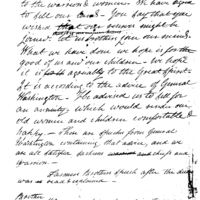
Appears to be speech made at Seneca treaty negotiations that began on August 26, 1797 and continued until mid-September. Cornplanter notes that his people have agreed to sell their lands. He hopes that what he has done is for the good of his children and agreeable to the great spirit. He notes that it is in accordance with the advice of General Washington who advised us to sell our land for an annuity, which would render our women and children comfortable and happy. He notes that General Washington's speeches gave us that advice and says that we are all satisfied sachems, warriors and chiefs. Farmer's Brother, after having had the deed explained, goes on to say (presumably to Cornplanter) that he and others have been thinking for several days about what Farmer's Brother has said. He says that Farmer's Brother has spoken for all of us. "Make your minds perfectly easy. We all understand it, every warrior present. And we are all perfectly satisfied."
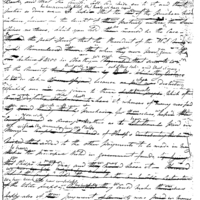
Farmer's Brother wants all of the annuities at once. He expects that surveyors will survey the lands, and hopes the U.S. will send a surveyor they can confide in so they will not be cheated. He expects the interpreter Jaspar Parish to be appointed in order to have errors in surveying explained. He wants all the surveys to be done at no expense to his nation. He hopes the white people will not take the land at their own price. His people wish to live in friendship to the Treaty and asks that Mr Israel Chapin, Superintendent, will take time to make the white man friendly to his people.
Colonel Wadsworth opens by saying he was unwell the previous evening and could not reply to the Seneca speeches. He says he is gratified that the Seneca nation is satisfied with the bargain made for their land. He promises that no one can take their money as long as the United States exists. Wadsworth asks that the Indians be precise in reporting their wrongs, and to go directly to Israel Chapin, who will report these wrongs to the President. He says he cannot promise that the $4500 annuity can be made in dollars instead of clothing and presumes it makes no difference to them. A law has been passed to prevent encroachments. He asks that they avoid white men who are not agreeable to Captain Chapin. Wadworth expresses happiness that the bad designs of the white people have been frustrated by this Treaty. He says that agricultural cultivation will make them grow as happy as the white men.
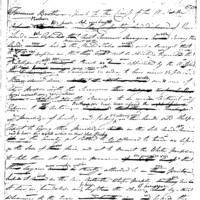
Appears to be the opening speech in a treaty negotiation between Jeremiah Wadsworth, US Commissioner, and the Seneca Nation. Makes references to desires of the President and Congress.