Adams mentions that he has only learned of his son's marriage through newspapers, but nonetheless wishes him and his bride a happy life together. Expresses surprise at Quincy's being "less than pleased" with his posting to Berlin [as part of the Legation to Prussia], and lists reasons why he should be enjoying it. Tries to ease any fears Quincy might have of nepotism from his father. Mentions that Quincy's brother will accompany him to Berlin.
Grayson replies to Simmons' request for an account of payments made at Wheeling. He owes the United States $51.80 and has it on hand to pay to whomever Simmons designates.
Pickering gives a blistering critique of the proposal by some to attack the ports of St. Louis and New Madrid, arguing that it is folly to go on the offensive. Pickering insists that if hostilities were to commence on the Mississippi, it would best to send the greatest force possible to that quarter. If American troops were thinly spread in ports across the Mississippi, Pickering argues, the force would be much weaker.
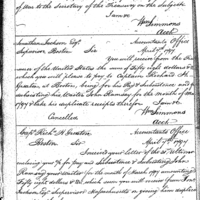
Simmons noted that law of Congress provided an inspector and authorized the Brigadier to chose him from the Captains and Subalterns. Maj. Cushing was appointed to position of inspector and claimed his allowance was stipulated by Act. Simmons requested info on allowance or emoluments since pay was suspended.
Wolcott advises the president on the safety of Philadelphia as a place for Congress to convene, given its recent outbreak of sickness; Wolcott assures him that it is now safe. Opines on U.S.-French relations, and on whether Adams' new envoys to France will be received. Says he believes no treaty will be accorded by the French until they have peace with England, since 1) it is in the interests of France to plunder U.S. shipping as long as they can get away with it because of the ongoing war, and 2) France will continue in her present course because she can have no exact idea of U.S.-British relations while the war lasts.
Certification that $9.44 is due Daniel Stephens [Stevens], Supervisor at Charleston South Carolina, being the amount of his account of commissions on receiving and paying monies from the War Dept. during the quarter ending Sept. 30, 1797.
Report from Benjamin Hawkins. Surveying of the Spanish border from the Commandant at Pensacola was premature. Hawkins reports that he expects a meeting of Indian chiefs of the upper and lower towns at Coweta, which Hawkins refers to as his neighborhood. He reports that the Creeks and the Chickasaws have made peace. There was a meeting of the chiefs of the "4 nations" (probably refers to Creeks, Chickasaws, Cherokees, and Choctaws). The plans of the U. S. government to "preserve peace and a friendly intercourse" with the Southeastern Indians has taken "deep root" and it is not in the power of the United States to destroy it. The agents deal with much vexations, but Hawkins says that they will persevere in fulfilling the duties enjoined. There is a narrative of a recent murder in a settlement [Tondaw?] of about 60 families. At the Tombigbee River there are 40 families. These settlements are on the United States side, first on the left bank of the Alabama and other on the right bank of the Tombigbee. They have Spanish rights for their land. The settlement on the Tombigbee is the one the Choctaws complained of in their conference with the Secretary of War.