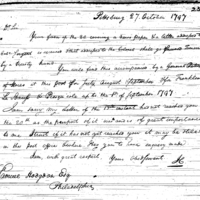
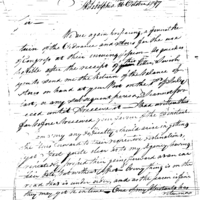
Comments on the likelihood of fever dying down in Philadelphia, allowing Congress to meet there. Informs Adams of meetings between a U.S. messenger and Talleyrand of France; comments on continuing friction between the U.S. and France. Mentions correspondence which covers the treatment of certain American ships in French ports. Mentions John Quincy Adams' inquiry to the Prussian minister of foreign affairs concerning the renewal of a commercial treaty between the U.S. and Prussia; quotes the reply of the Prussian minister, in French. Refers also to negotiations and treaties with England and Russia.
Informs Adams about the chances of yellow fever in the city of Philadelphia, claiming that the onset of winter will stop the sickness; reminds Adams of his authority to recommend a change in meeting-place for Congress.
Has written to Secretary of War soliciting appointment to one of the United States frigates. Is anxious to be in Navy; asks Henley for a letter of recommendation.
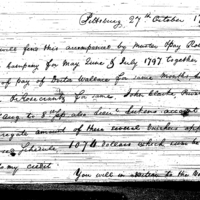
Captain Bell sailed from New York on Sunday and is expected to return immediately. Captain McRea, for whom the clothing is intended, took passage with him and should return within a fortnight.
Accounts of several officers, companies, and a doctor enclosed. Enclosed estimate of pay for troops at upper posts of the Ohio river. List of expenses included.
Basic correspondence between President John Adams and Secretary of War James McHenry in which Adams largely agrees with the sentiments of McHenry and other officers such as General James Wilkinson.
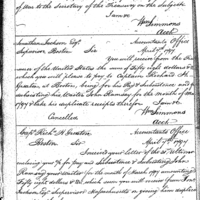
Two receipt rolls for pay of Blackburn and detachment for July and August received. Deductions made to pay of Benjamin Noter, Matthew Madden, William Hughes, Forman Berston, Isaac Smith, Fielding Harding, John Willroy, David Griffith, Thomas Reeder. David Patterson, Michael Shannon, Benjamin Wells, Cuthbert Shelton all overpaid. Sum of $647.98 passed to the credit of Blackburn's account. Simmons requests attention to detail to avoid future errors.
Jackson will receive credit to his account in amount of $687.50 for receipts of George Claghorn and Caleb Gibbs regarding their compensation for July through September.
Comments on the fact that the president seems to have requested a box at a theater in Philadelphia; [goes on at some length, but is largely illegible due to faint ink].
Notifies Hodgdon of a number of recent bills drawn, and of his intent to provide bills for the doctor of the post at Pittsburgh while Wilkins remains there. Asks Hodgdon to pay the Treasury Office for money due on a land certificate held by Wilkins, and charge the same amount to him in the quartermaster accounts.
McKee writes from Mobile, informing McHenry that he is temporarily being held prisoner by the Spanish governor of Louisiana, Gayoso, and that he expects to set off to New Orleans the following day. McKee was suspected of being in league with William Blount, a U.S. Senator from Tennessee found to be working a plan to aid the British in conquering West Florida by inciting the Creek and Cherokee against the Spanish. McKee also suggests that the Spanish have no intention of enforcing the terms of Pinckney's Treaty from 1795, which required that neither side excite Native Americans to warfare against the other.
Preparing return of ordnance stores for Congress, requests return of stores on hand at Craig's post. Illness in city is nearly gone, effects not nearly as bad as those of 1793. Receipt of T. Martin lost, requests a duplicate receipt.
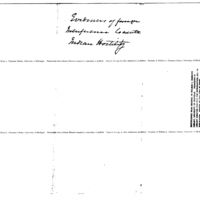
Memorandum containing evidence from the last few months of foreign interference in order to excite Indian hostility against Americans, particularly on the part of the Spanish - in clear of violation of Pinckney's Treaty. Surprise attacks and the arming of Indians are common themes.
Adams mentions that he has only learned of his son's marriage through newspapers, but nonetheless wishes him and his bride a happy life together. Expresses surprise at Quincy's being "less than pleased" with his posting to Berlin [as part of the Legation to Prussia], and lists reasons why he should be enjoying it. Tries to ease any fears Quincy might have of nepotism from his father. Mentions that Quincy's brother will accompany him to Berlin.