Smith denies the charges brought against him of violently advocating an election upon principles unfriendly to the Constitution which he fears may cause the Senate to reject his nomination as Adjustant General of the Army. He asks McHenry to present him to the President as a candidate for a commission in the twelve thousand being raised.
Smith, American Minister to Portugal, reports to the Secretary of State on the news from Lisbon, especially that which relates to the ongoing quasi-war with France.
Clothing and muskets have been sent to Capt. Bishop's address and a receipt should be given to the bearer confirming that the packages were delivered entire and agreed with the invoice.
Certification that sixty dollars is due Lieutenant Ferdinand L. Claiborne of the 1st Regiment, being his pay as Quartermaster for May through October 1796 in addition to his pay as Adjutant.
Certification that $412.14 is due two detachments at Fort McHenry under the command of Captain Staats Morris, being for the pay and subsistence of Lieutenants Philip Landais and Samuel Dyson, and the non-commissioned officers and privates for July 1798.
Certification that $72 is due William Littlefield, Captain in the 1st Regiment of Artillerists and Engineers, being for bounties paid and premium allowed him for reenlisting four soldiers.
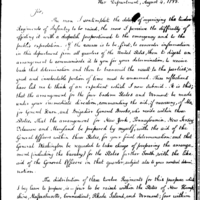
McHenry states that the provisions for raising the 12 new regiments of infantry will be too time-consuming if orchestrated from one central location; proposes that 3 districts be created for this purpose. Adams (with the help of Generals Knox and Brooks) will handle New England; McHenry will take care of the states between New York and Maryland, and Washington will take care of Virginia and all states south. Anticipates the raising of 4 regiments in each district. Proposes officers for regimental command. Asks permission to delegate some responsibilities to General Knox and the Inspector General among the myriad tasks of organizing, equipping and regulating all the new troops. Relates that he is pressing for the production of new muskets at Springfield as quickly as possible; for now he recommends that government muskets be kept for federal use, and not loaned out to volunteer companies. Also notes that a large outbreak of yellow fever has occurred in Philadelphia, and anticipates the removal of the public offices to Trenton.
By order of the Secretary of War, Craig has dismissed and paid off all the ship carpenters from Philadelphia except the superintendent and five others who are needed to complete and launch the galley. This cannot happen until a considerable rise of the waters of the Allegheny takes place.
Craig has received a letter from Samuel Lewis enclosing a post note for one thousand dollars, $300 of which is appropriated and $700 is for the pay of the troops of the upper posts.
Frye encloses the receipt roll, receipts of Lt. McCallen and Dr. Osborne, muster and pay rolls. He explains some of the measures he has taken in the pay rolls for deserters who have surrendered, persons under court martial, etc.
Among other matters, Hodgdon discusses the policy regarding sending drafts with or without stamps. The Quartermaster General may receive them without stamps but the banks will not, so it is best to draw on stamped paper.