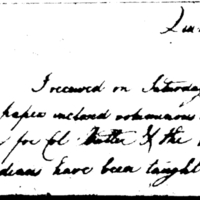
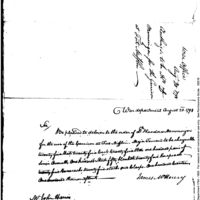
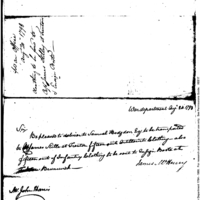
Acknowledges receipt of McHenry's letters concerning treaty negotiations with the Cherokee. He confirms the commission of Col. Butler as an Indian commissioner, and comments on the root of the problem: "The Indians have been taught to misunderstand the advice against selling their land to individuals, for advice against selling to the United States."
Speaks of [illegible name] who serves the government, particularly in South Carolina, with an appointment in the provisional army. Left Philadelphia to discuss matters with generals in the Pennsylvania Army. Refers to David Knowles and the Cherokees. Details communications and plans with various officers. Mentions infantry uniforms and arms for various companies. Lists Wilmington District names (many illegible).
This letter recommends Jeremiah Clapp for a position in the U.S. Army. Major Clapp was in the First Brigade of 3d Division Massachusetts Militia and has conducted with great military propriety in that office. He has natural genius and talent. Baldwin vouches for Clapp's federalist political credentials; he is strong supporter of the government and the constitution.
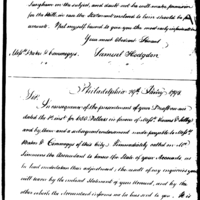
Among other matters, Hodgdon expresses his determination to maintain the public business in the face of many departures from the city due to the fear of contagion,
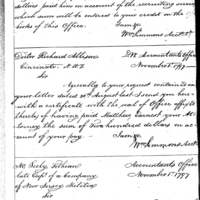
Certification that $6.67 is due Captain Richard S. Blackburn of the Corps of Artillerists and Engineers, being the balance of his account embracing bounties to soldiers, expenses of recruiting, incidental and contingent expenses, and monies remaining in his hands from the pay of himself and the detachment under his command at Fort Norfolk, for February 1797 through May 1798.
Wilkins sends five abstracts for disbursements of cash to various departments, including the hospital, Indian, provision, ordnance, and Quartermaster's. He asks that Steele acknowledge receipt of the abstracts and accompanying packets.
On Talleyrand's defense of the XYZ Affair, the course that will probably be pursued by the U.S. government, and the embargo. McHenry also weighs in on public opinion and the influence on elections, insisting that anti-Federalists are in the minority and that American opinion is nearly unanimous in opposing France.
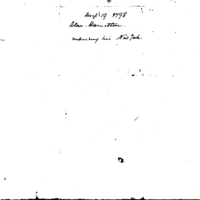
Hamilton expresses his bewilderment that General Knox seems reluctant to serve as his subordinate in the Provisional Army and encloses a draft of a letter that McHenry can use as a response to Knox.
Alexander Hamilton acknowledges James McHenry's suggestion to the President calling Hamilton and Henry Knox into immediate service in the Provisional Army. Hamilton assures McHenry that he is willing to accept the appointment, but insists that he does not want an immediate change of residence. Hamilton concludes with a response to some of Knox's criticisms to McHenry and recommendations for officers.
Byers is part owner of a blast furnace in Springfield and stands ready to provide the United States with cannon balls. He wants to know who negotiates contracts for the US, what quantity and size of balls are needed, and how much per ton would be paid for delivering them to the public store.
Fleming explains that that there is not a haversack at West Point that is fit for a pattern. He expresses his sorrow that the yellow fever has visited Philadelphia yet again.