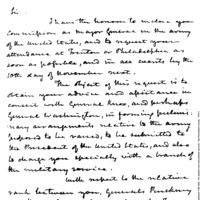
Encloses commission as Major General in the US army and requests presence at Trenton or Philadelphia for advice and assistance with Knox and Washington. Plans to raise an army to submit to the President. Considers nomination and support from the Senate.
Acknowledges receipt of commission as inspector and major general; states that he will defer his journey until late October, so as to arrive [presumably at Philadelphia] around November 1. Observes with satisfaction the relative rank of the major generals, and promises to send a response to an inquiry of McHenry's after consultation with other officers.
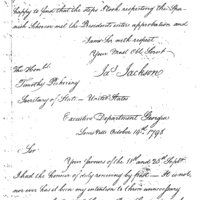
Jackson objects to the President's calling into service the Militia of Georgia because such an action would leave that State and its citizens unnecessarily vulnerable to invasion. Since ordering northern troops into Georgia would expose them to unhealthy conditions, it seems reasonable to man the State's garrisons with local militia rather than having them sent to posts outside the State.
Pinckney states that he learned of his appointment as major general via a newspaper while en route from France to America; asks that McHenry inform Adams that he will accept the commission. Requests permission to see his wife and daughter to Carolina before returning northward, and also requests a commission for his former secretary, who has spent time studying military books and observing foreign troops in Europe. Recommends him on several counts.
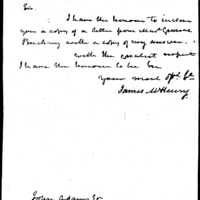
Encloses Pinckney's commission of Major General of the Provisional Army and reaffirms the relative rank of the Major Generals despite the surrounding controversy: Hamilton, Pinckney, Knox.
James McHenry had solicited the opinions of the Secretaries of State, Treasury, and the Navy on the matter of seniority for the Generals selected by George Washington for the Provisional Army. The Secretaries agree with Washington's arrangement of rank: General Knox first, General Pinckney second, and General Hamilton third.
Wolcott expresses concern for promised Charlesville-pattern muskets. Refers to previous correspondence with Mchenry and with George Fleming, storekeeper at West Point. Fleming was disappointed in the inability to provide the right pattern, but believed that in 1793, 2000 patterns existed in Albany and 5000 at Springfield. Refers to correspondence with John Harris in Philadelphia and John Dexter in Rhode Island about musket patterns, sending others to Baltimore. Contractors depend on the public store for their supplies. It is Hodgdon's duty to provide supplies as promised.
General Washington has agreed to accept his commission as Commander in Chief so long as Alexander Hamilton is appointed Inspector General and Charles C. Pinckney and Henry Knox appointed as the other two Major Generals. The President doubts the propriety of such appointments arguing that General Knox should have the highest rank. Nevertheless, the Secretary of War should inform the three generals of General Washington's decision
Due to a misunderstanding, the six pattern Charleville muskets have been delayed but will soon be transported to Baltimore, although by a more expensive mode.
Pickering forwards correspondence from France, namely reports of the Directory's raising of the embargo on American shipping and the departure of General Pinckney for America. Remarks that the wife of Lafayette has been imprisoned in France. Also notes that he has received letters from John Quincy Adams at Berlin, currently renewing a treaty with Prussia, and encloses a private letter for the president from a Mr. Murray.
McHenry requested the examination of the enclosed letters regarding the commissions of officers. If the recipients concur on their opinions of the letter, then the opinion should be transmitted to the President. Listed points McHenry wanted addressed. Subjects dealt with commissions and the method in which the commissions should be approved and communicated.
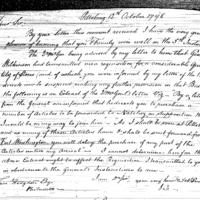
Received notification that Gen. Wilkinson ordered a significant quantity of stores, Craig will abstain from making any additional orders until quantity is received.
Though General Wilkinson had transmitted to Craig a requisition for a large quantity of stores to be transported to Natchez, the Quartermaster General has ordered a suspension of that business. Many of these articles will be forwarded from Fort Washington so the purchase should be delayed until the QMG reaches Pittsburgh.
Enclosed is the draft on Hodgdon from John Wilkins for one thousand dollars which should be accepted and returned to the credit of Meeker & Denman on the Bank of the United States. (A second letter from Mr. Williamson for Samuel Meeker, dated 10/12/1798, asks Hodgdon to order the amount of the draft sent to the credit of Samuel Meeker on the Bank of the United States.)