It is recognized that the expenses entailed in the pursuit of Mr. [Griffith] McKee's duties, including the employment of special messengers to convey his corrspondence, the need for quarters at the various places he was required to visit, and horses he had to hire, should be born by the United States.
Craig has purchased at a public auction of the Commissioners of Pennsylvania two lots at LeBeouf which he considers necessary for the United States to possess since they adjoin the grounds on which the public buildings are erected. He presumes that McHenry has made the proper application to the legislature of Pennsylvania who can be expeted to cede the property to the United States.
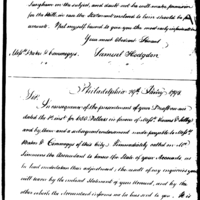
Acknowledges receipt of several late favors. Encloses the requested account. Promises his best attention, advice, and information as soon as he can collect it.
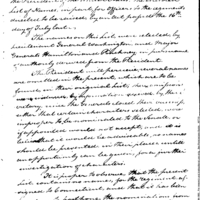
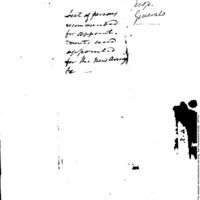
Presents list of names of regiment officers, submitted by Gen. Washington and Major Generals Pinckney and Hamilton. Speaks of nomination process between military leaders, the President, and the Senate. Postpones nomination for regiments in Connecticut, North Carolina, South Carolina, and Georgia.
Culbertson recommends himself and Joseph Parks, with three or four teams, to do the government's hauling to different parts of the country. After receiving proper wages, he and Parks will see that the public's loads are transported safely consistent with Hodgdon's duty as a public officer.
Among the stores being shipped to Natchez are those addressed to Governor Sargent on board a boat in charge of Judge William McGuire. Craig has not heard of the boat being stopped by ice but he has reason to believe that it could not have proceeded very far without being impeded by ice.
Refers to letter concerning Gov. Sargent's business, his trouble with his property and the weather and transportation. Speaks of the Great Council: Secretary of State, Secretary of Navy, Quartermaster General, and other friends, who will dine with Hodgdon. Reports rumor of Navy Armament. Refers to correspondence with Major Kirkpatrick and Wilson's account with the Quartermaster General. Promises to send duplicate of requested artifacts by ship to Orleans. Suggests contract with Natchez.
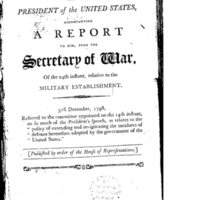
McHenry notes that the President has not commented on his list of nominations of officers for the Additional Army. He has finished his report to the President on American military affairs and awaits the response of Congress. It would not be wise to appoint a foreigner to lead the 2nd Regiment of Artillery.
The President has requested a list of nominations for observations from the department heads. Smith's name will stand. Has heard nothing from General Pinckney about a military school. Seeks President's opinion, as well as Gen. Washington and Congress. Mentions artillery requirements.
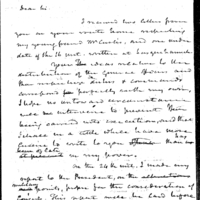
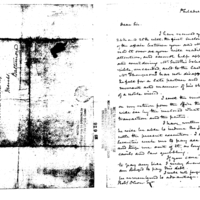
McHenry assures Washington that his ideas relative to the distribution of the general officers and their respective duties and commands correspond with his own. McHenry has reported to the President on the military points which will also be presented to the Congress. Several of the officers named for the eastward will not accept and a few others do not deserve to be appointed. Washington's letter respecting Colonel Smith has been shown to him and to the President.
Along with an exteract explaining many of his thoughts on internal defense, Hamilton includes additional observations regarding the reduction of military forces, the efficacy of militias; defects in the military establishment, the Provisional Army, and appropriations for fortifications.