After inspecting Captain Bryant's returns, Williams surmises that many of the principal articles deficient are due to the proper deductions not being made for deliveries and expenditures. Bryant admitted that the military stores in the magazine would not agree with his return.
Major Craig reports to Samuel Hodgdon that the stores destined for Natchez have arrived safely at the falls of the Ohio. However, due to ice on the river, further transportation of the stores is delayed.
Because the climate of the Mississippi does not agree with him, Glen would like to return to the Atlantic states and offer himself for a position on Hamilton's staff.
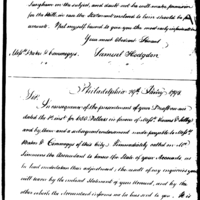
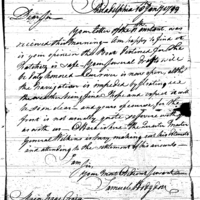
List of items to be transported to Major Craig at Pittsburg includes wine, coffee, and sugar. Hodgdon asks that they be made ready for transportation as early as convenient.
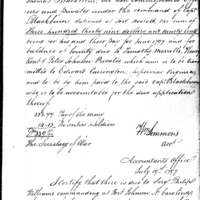
Seeks to discharge bills drawn by Quartermaster General amounting to $1,828.78, and to pay a balance to Peter Hunt for $719.93. Requests warrant for $2,548, charged to the Quartermaster General.
Acknowledges letter and information from Governor Winthrop Sargent's goods. Includes figures for shipping items to the Natchez by sea. Adds value of insurance with the great risk of privateers. Hopes to resolve issues soon with Forrest and with Campbell.
Discussed shipment of goods going to Natchez and method of payment. Will attempt to settle Campbell's accounts. Expects Craig to travel to Philadelphia in the distant future.
Secretary of War wants to know arrangements for procuring seasoned musket stocks: present state of contracts, number in the public store, which ones have been ordered by him.
McHenry informs Hamilton that he has been unable to obtain any information on appropriations provided by the House of Representatives for the new army.
Notes that the situation of St. Domingo [Haiti, now in slave revolt] poses some dangers to American interests, but also opportunities. Mentions discussion with Lord Grenville of England regarding concerted English and American action regarding Haiti, in which comparisons to American slaves were discussed. Says that a common opinion was not agreed upon, other than a strong feeling that each country should respect the other's wishes with regards to St. Domingo. Grenville believes the colony will achieve independence, and wishes to establish trade with the new nation in order to prevent its depending on piracy. They believe that Dominican independence will inevitably affect France's other Caribbean holdings, perhaps leading to the wholesale downfall of the colonial system in that region. Speaks of a proposed company to oversee trade with the new nation, but notes this would be seen as a monopoly by American merchants; discusses various solutions for dividing trade between Great Britain and America and treaties with Toussaint L'Overture, the Dominican leader. Assures Pickering that the English are prepared to cooperate with the Americans in this matter.
Jones writes concerning the state of those living in the Illinois country, explaining the conditions that aided in the area's decline. Jones cites the conscription of provisions by General Clark's troops as a factor.
Reports the store's 3,288 black walnut musket stocks, and they should be receiving 1,000 every three weeks according to outstanding contracts, until by the end of April they should have 8,288 + stocks, with very few deductions to be used to supply national armories. They will not all be completely seasoned at that time. It will be easy to receive 1,000 stocks every 8 days. While he has no power to interfere with contracts, but is anxious to supply musket stocks equal to the whole number procured. Refers to 2,000 gun stocks deposited in Tench Francis's store not included in previous calculation.
Certification of payments; $120.83 to Doctor Samuel Conrad for medical assistance rendered recruits under Captain John Bishop, 2d Regiment, Artillerists and Engineers, payable to David Jackson.