The formal statement of Robert Ellis, bookkeeper in the Accountant's office, regarding an angry confrontation between Captain Samuel Vance and William Simmons.
Abbot, a clerk in the Accountant's office, gives his formal statement regarding tthe confrontation between Capt. Vance and William Simmons, in which Vance accused Simmons of being a rascal.
This is a formal statement by Peter Hagner regarding the confrontation between William Simmons and Captain Samuel Vance in which Vance accused Simmons of being a villain.
Lewis received $9700 to be transmitted to Nathan Starr of Middletown Connecticut for manufacture and delivery of 2000 cavalry swords, with scabbards and belts.
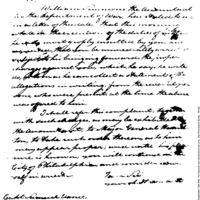
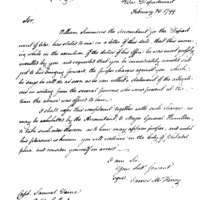
Responds to William Simmons's claim that Vance grossly insulted him and requests immediate repercussions. Forwards complaint to Major General Hamilton.
McHenry advises Captain Vance that William Simmons will press charges against him for grossly insulting him while he was performing the duties of his office. Vance is to remain in Philadelphia and, pending the issuance of formal charges, will consider himself under arrest.
Hamilton has asked Colonel Stevens to procure the article stated to be wanted and has asked the Accountant of the War Department to pay for it by deducting the amount from the pay of the soldiers.
Phinney, Morris, Edwards, and Griffin recommend Lieutenant Willard Warner of the county militia for a Subaltern's commission in the Army of the United States.
Cited in Simmons to McHenry, 06/19/1799. Letter from Samuel Hodgdon, Commissary of Military Stores, to Colonel Ebenezer Stevens, agent for the War Department in New York.
McHenry apoligizes for not being able to send the distribution aksed for by Hamilton. He asks for Hamilton's assistance in understanding the intentions of General Washington regarding the assignment of stations to infantry regiments.
Captain Ingersoll provides a detailed report of the state of readiness of his command, including a description of the buildings he is using and the surrounding terrain in addition to his returns of clothing and arms.
A letter is enclosed to Colonel Parker which explains the recruiting service within the State of Virginia. If Lee himself can digest the information it need not be sent to Parker since the recruiting service will not soon begin.
The bearer, Mr. Vanderherchen, is believed to be an honest and industrious man with a family to support. He is out of work and, if given public work, he will do whatever he undertakes with integrity.
Having nearly completed the inspection of the clothing contracted for by Mr. Billington, Mr. Francis wants Steele and Ewing to inspect that previously sent for by the United States. The compensation is understood to be proporitional to that agreed on for Billington's contract.
Hamilton asks Washington to dispose of the enclosed letters so as to achieve a speedy distribution of the state of Virginia into districts and sub-districts.
Associated with his duties as Inspector General, Hamilton announces that he is now superentendent of the recruiting service. He directs that the State of Massachusetts should be divided into four recruiting districts and twenty sub-districts and from each sub-district one company is to be recruited.
Anderson explains why he has not forwarded a return of business and expenditures for the year 1798. There are so many small parties sent in separate directions that he scarcely has an hour's leisure so it has been impossible to make satisfactory returns.
Washington is informed of the disposition of military affairs and warned that obstacles may stand in the way of a successful management of military concerns. In the future, Hamilton's confidential letters will include code names for certain high level government officials.
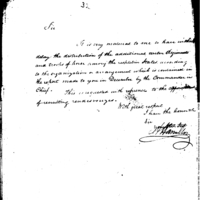
Requests distribution of additional twelve regiments among the respective states according to arrangements made in December by the Commander in Chief. Seeks information for recruiting purposes.