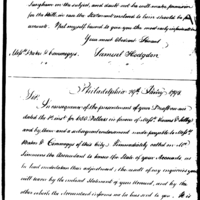
Anxious to adjust and close accounts of Mr. Faesch. Must first determine if the shot provided is taken for the use of the states and where it is located. Requests direction on how to proceed. If Hodgdon is to attend to the business, he requires a few days' advance notice to alert Faesch.
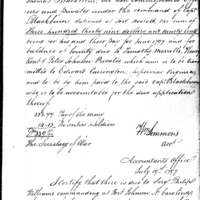
Certification of payments; $60 to Jonathan Rhea for compensation and expenses in making contracts of articles for the posts of Rendezvous in New Jersey, to include Hackensack, Elizabeth Town, Trenton, New Brunswick, Burlington, New Jersey.
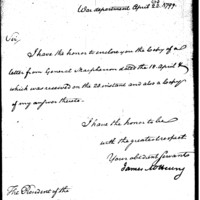
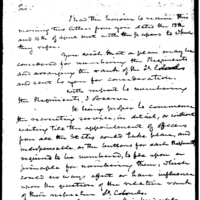
Refers to the appointment of officers and the numbering of regiments. Seeks careful governance. Plans to raise regiments in North and South Carolina and Kentucky, with plans in New Hampshire, Vermont, and Rhode Island.
Discusses need to number the new regiments, so that recruiting may begin and buttons may be issued, in a fashion that does not affect the relative rank of the officers now being appointed for those regiments. Dictates that the numbering of the regiments (and thus their lieutenant colonels) be geographical, starting with those recruited from the southernmost states. Discusses the overall system as it relates to the relative rank of the officers of the original four regiments as well.
Refers to Captain Charles Hyde as settling large sums of money, working with the regimental paymaster. Refers to an act to better organize the troops and plans for promotions. Mentions potential role as principal accountant of the War Department.
McHenry explains the pay incentives that are available for attracting drummers and fifers and the circumstances in which extra allowances are allowed for officers.
Gibbs has not yet been given an appointment and renews his request for one. He would like to be in the staff, possibly as Deputy Quarter Master General, and addresses his request to Washington at the suggestion of the President.
Routine correspondence concerning the appointment, transfer, promotion, discharge, desertion, leave, and assignment of individual officers and soldiers and routine instructions and correspondence concerning Army recruiting.
Hunt reports that express rider Robert McCrea was robbed of bills of exchange en route from Natchez to Cincinnati to Lexington. Robbery of $25,000 was near the Tennessee River by either Indians or white men.
Routine correspondence concerning the appointment, transfer, promotion, discharge, desertion, leave, and assignment of individual officers and soldiers.
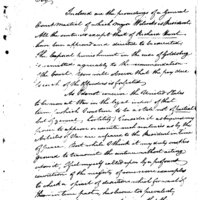
Hamilton transmits the results of a General Court Martial, nothing that the punishments are mitigated in some cases by the fact that the United States is not officially at war.