Captain Vance court martial discussed and the supposed threats of personal punishment of Vance by W. Simmons. Civil and military court rules described.
Hamilton affirms that there can only be one rule for promotions in the Army and notes that distributing the older Captains among the four regiments of the old establishment may ameliorate possible anquish on their part.
Wolcott maintains that no loss should accrue to the United States as a consequence of a robbery. But should attempts be made to negotiate the bills, such attempts should be made public through the medium of the newspapers.
Reports that the Secretary of War states that extra allowances of clothing are not permitted because the supply in the store is not enough. Sends the extra clothing from the last contract. A magazine in Boston will be established to supply clothing and tents. The Secretary believes good tents will contribute to good health.
Has received invoices of goods received for the Indian Nations: Piankashaws, Patawatimies, Kaskatias, Kikapoos, Weaa, and Eels. Their annuities have been forwarded.
Plans to leave Philadelphia next week for NYC to examine Faesch's castings. He'll first stop in York to examine John Blagg's store, then to Elizabeth Town to examine shot there. Requests that Faesch go early and assemble all stores and make a report.
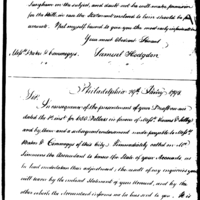
Plans to go to Elizabeth Town and New York city to inspect the castings of John J. Faesch. Requests extract of contract and any other documents for the examination. Received receipts for Ebenezer Stevens's muskets and notes that Stevens found deficient accounts for muskets, gunworm, cases, brushes, and wires.
In response to his letter, reports that Winthrow is in the employ of Mr. Harris and cannot come to Craig's assistance. Hodgdon promises to search for some other means of assistance. Remainder of annuities are on their way. Forwards letter to Mr. Ernest with receipts from the shipwright at Detroit.
McHenry argues, contrary to President Adams' assertion, that the President is not authorized by the Constitution to make appointments to the Army without Senate approval when the Senate is in session unless allowed to do so by an Act of Congress.
Routine correspondence concerning the appointment, transfer, promotion, discharge, desertion, leave, and assignment of individual officers and soldiers and routine instructions and correspondence concerning Army recruiting.
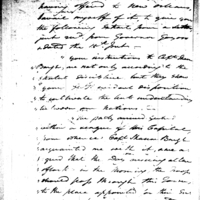
Wilkinson encloses a confidential extract by Governor Gayoso of Louisiana who expresses his approval of the state of accord existing between his nation and the United States.
Wilkinson includes an extract of a letter from Governor Gayoso in which the cordial nature of Captain Shaumburgh's expedition to New Orleans is viewed as evidence of friendly relations between the United States and Spain.
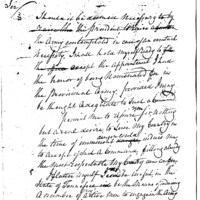
Reports himself prepared to accept a commission in the provisional army, which he had been nominated before, should that force actually be approved. Discusses his usefulness in the Tennessee region, and willingness to recruit patriotic men for the army.
A detailed description of the arrangement of the artillery for the following; for the Western Army; for Georgia and South Carolina; for North Carolina, Virginia, and Maryland; for Delaware, Pennsylvania, New Jersey, and New York; for Connecticut, Rhode Island, Vermont, Massachusetts, and New Hampshire; and for the Field.