Regarding the galley "Senator Ross," Hamilton recommends to Colonel John Francis Hamtramck that the boat destined for Fort Massac go instead to the lower posts on the Mississippi River.
Hamilton recommends that the galley "Senator Ross", recently built at Pittsburgh, should be employed on the lower posts of the Mississippi and manned by officers and men detached from the line who have the necessary marine knowledge.
Recommends consultation with General Schuyler about the magazine at Albany. Requests that he be empowered to adjust claim as he has assisted well in the past.
Reports that the Secretary of War will assist in remedying the embarrassing situation regarding the rent due for powder magazine. Through the multiplicity of business this has been overlooked until now.
Submits a plan for resolving the issue of relative rank between the officers of the 12 new regiments. Mentions as primary a concern to avoid comparisons based on merit, which might offend some of the men. Suggests that for men who served in the Revolutionary War, their rank at the close of that conflict should govern. These seem to be ranked first over men who have served in the army at some point, and those in turn over men who have not seen any service. For those who have some experience, merit or lot should decide seniority. Also proposes a plan for managing promotions within the army that was originally conceived by General Washington -- that, excepting extraordinary circumstances, officers rise within their regiments until the rank of major, when they may rise to any unit; officers may not be promoted to another corps (infantry, artillery or cavalry) until having reached the rank of colonel. Proposes reconciling these regulations with the officers who enlisted under the previous system, but notes that one unified promotion system must result. Asks for Adams' approval on these plans.
Declares the number of officers needed to complete the set for the new regiment being raised in Pennsylvania, namely one captain and five lieutenants, and encloses recommendations for each post.
McHenry discusses officers' pay related to additional regiments and describes executive power respecting officers' pay. He mentions the recruiting service for additional regiments and discusses supplying additional Army regiments.
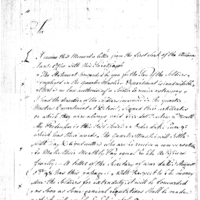
McHenry stresses the importance of keeping General Washington well informed so that when he does take command, he can do so with the knowledge he needs to be an effective commander.
Among numerous complaints, Rivardi questions the accountant's rejection of extra pay for extra duty and laments the state of his health which has been sorely diminished by intermittent fevers and violent headaches due no doubt to the harsh climate at Niagara.
Routine correspondence concerning the appointment, transfer, promotion, discharge, desertion, leave, and assignment of individual officers and soldiers.
Rivardi asks that soldiers of the quartermaster's department receive extra pay for extra work and that Dr. Coffin be paid for his additional responsibliities. He complains that his poor health forces him to ask to be relieved of his duties unless he is assigned to West Point which has a more favorable climate.
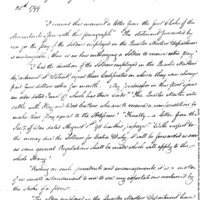
Dispute over extra pay awarded soldiers in Detroit. Rivardi quoted multiple documents by several authors supporting his claim for extra pay, disproving Simmons verdict of "inadmissible" on Rivardi's claim.
Refers to authority of the commander-in-chief of the army, who has declined responsibility in its affairs. Requests information preparatory for when the commander enters action.
Van Rensselaer has drawn on William Simmons for the money due him but his account with Hodgdon remains unsettled due probably to his receipts not yet being lodged in Hodgdon's office. He asks Hodgdon to use his influence with Simmons to reach a settlement.
Wilkins warns that Hodgdon's account of bills drawn by Samuel Harragan differs considerably from the settlement that took place between him and Harragan. Harragan never was authorized by Wilkins to draw bills but General Wayne ordered him to raise money by drawing on the Quartermaster General which he did.
Five-page list of vouchers delivered by Ensign Hugh McCall, Paymaster to the Federal Troops in Georgia, to John Habersham on behalf of Lt. Truman, agent for the War Department, to be submitted by him to the Accountant of the department and passed to the credit of said McCall.