Routine correspondence concerning the appointment, transfer, promotion, discharge, desertion, leave, and assignment of individual officers and soldiers.
Expresses the Baltimoreans' concern that insufficient money to finish the fortifications at Fort McHenry will leave the harbor defenseless. After affirming Baltimore's vital state as a port, Gilmer re-states the issue of the fort thus far, concluding with the point that Major Tousard estimated a cost of almost $31,000, while only $20,000 was allotted by the federal government. Notes that the superintendent government engineer, Mr. Foncin, has found that additional parts of construction are necessary which were not part of Tousard's original estimate. Says that the hoped-for voluntary contributions of the citizens will not be sufficient to make up the needed difference, now estimated at $32,000 after Foncin's estimates. States hope that the government will invest additional funds in Baltimore's fortifications. Mentions that the current project, the "tower battery," will be continued to completion, and annexes Foncin's new set of estimates.
Tracy informs McHenry that he will soon provide a list of a selection of officers for the Provisional Army. Tracy also insists that McHenry treat the recent John Fries's Rebellion in Pennsylvania with absolute severity in order to make an example out of them. Tracy criticizes what he considers a weak response from President Adams.
Routine correspondence concerning the appointment, transfer, promotion, discharge, desertion, leave, and assignment of individual officers and soldiers.
Certification of payment; 218.83 pay to detachment 1st Regiment Artillerists and Engineers stationed at Fort Mifflin under command of Captain Ebenezer Massey, for pay and forage.
Refers to court proceedings for Lieutenant James Triplett. States that it is proper for the US to provide barracks for officers, distinguishing between captain and field officer. Requests information about proposals.
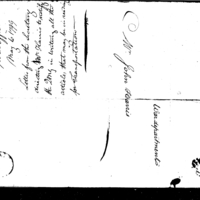
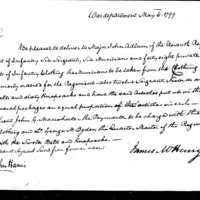
McHenry instructs Harris to notify the quartermaster general in writing anytime ordered articles are ready, that arrangements for their transport can be made.
Amidst a discussion of a number of accounting matters, Ernest surmises that of the $180 advanced by Hodgdon to Bradshaw and Cook, $108 is intended for their families in Philadelphia.
Williams lists the quantity and tonnage of rolled iron he will require for sundry purposes at the Springfield Armory. He emphasizes the pressing need for iron at this factory and urges Hodgdon to forward it soon.
Mackey notes that the upper level of the Potomac River is now marked and preliminary steps for digging have already begun with over one hundred men employed in that effort.
Captain Guion discusses his paymaster's account which was complicated by the violent theft of the original bills from the express on his way from Loftus Heights. The replacement bills should be honored while the original bills, having been stolen, should not be honored.