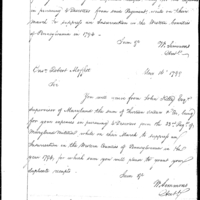
Routine correspondence concerning the appointment, transfer, promotion, discharge, desertion, leave, and assignment of individual officers and soldiers.
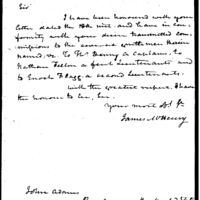
Acknowledges receipt of Adams' order for the commissioning of several individuals -- one captain, one first and one second lieutenant -- and states that he has mailed their commissions.
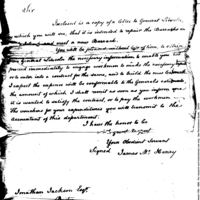
Jackson will obtain from General [Benjamin] Lincoln the necessary information regarding repairing barracks and building new ones so that he can proceed immediately in engaging workmen to make the necessary repairs or enter into a contracts for repairs and for building a new barracks.
McHenry has given orders to Jonathan Jackson to have repairs made to existing barracks and to build a new one. The new barracks will be used as a temporary hospital and should not be located anywhere where it would be an obstruction to the defense of the place.
McHenry warns that provisions to the Indians should be given with the strictest economy unless their affections are diminished. He worries that the land speculation may anger the Indians but advises patience until the intentions of the Indians are known. The soldiery do not seem distrubed by being obliged to find cockades and loops for their hats.
Despite the reduction of the rates authorized by Congress for the purchase of rations, Mr. William Colfax, the contractor for supplying the troops at Fort Jay and West Point, has continued to charge according to the former rates. Although it is probable that Colfax was unaware of the reduction, he should be notified immediately and no action taken against him that might embarass the service.
McHenry complains that the business of the War Office is sufficiently extensive and should not be burdened with requests to approve the sentences of garrison courts-martial. The Articles of War require the President's approval only for sentences in capital cases heard by General Courts-Martial.
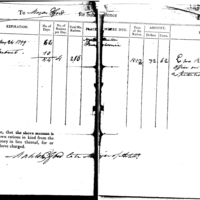
As commanding officer of the North Hampton expedition, Major Ford certifies that he has drawn 216 rations over the course of 54 days (four rations per day) at a cost of $32.62.
Refers to the correspondence from the Surveyor General about when and where he plans to establish the Indian boundary. He agrees that expediency necessitates that the assistance he requires in marking the boundary should come from the Commanding Officer in the Northwestern Territory.
Miller admits that he does not understand how the books of the Quartermaster's department for the public stores balances with Hodgdon's plan.He would like Hodgdon to honor Mr. Banger's request to show Mr. Wilson the entries made from the beginning until the transmission of the amount to Miller.
The Surveyor General confirms the expediency of directing the Commanding Officer in the Northwestern Territory to provide the troops who will assist in marking the Indian boundary line.