Concerning vacancies in Colonel Taylor's regiment; states that it will not be too late for him to alter a list of recommended appointments to be sent to President Adams.
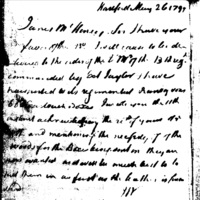
Returns copy of letter to Colonel Hamtramck. Reminds him that troops in Tennessee and the Georgia frontier were under General Pinckney's command. Seeks transportation assistance from the Secretary of the Navy for Captain Fry's company to Charleston.
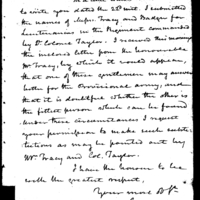
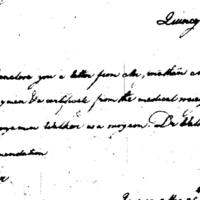
Reminds Adams of two men whom McHenry recommended for lieutenancies in Col. Taylor's regiment, but based on further information has decided that one is not appropriate for the post, and asks for permission to amend the recommendation based on the advice of the other potential lieutenant and the regimental commander.
"I have this moment received your letter of the 24th and several enclosures, among the latter a letter to Lt. Col. Hamtramck which I return for your reperusal. You will recollect that the troops in Tennessee and on the Georgia frontier are within General PInckney's command. Your letter to Hamtramck extends his authority to the troops in Tennessee. Will you be pleased to have this corrected..."
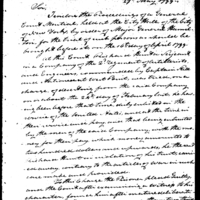
Forwards the proceedings of a court-martial held in April at New York City, convened by the order of General Hamilton. Sgt. Richard Hunter, of the 2d Regiment of Artillerists & Engineers, was charged with desertion and of carrying off the payroll funds of his company, with which he was entrusted. Hunter pled guilty, and was convicted on all charges. McHenry notes that desertion is prevalent among the troops, and suggests that reinforcing examples will help assuage this. McHenry believes Hunter a fine candidate for military execution. Encloses the forms of both a pardon and a warrant for execution, subject to the president's wishes.
Sedgwick expresses concern of the growing opposition to the Federalist Party, spurred in part by the regular pay of officers in the Provisional Army before they performed any actual services.
Hamilton seeks general uniformity relative to the various parts of the Army, including the volunteer corps, with the understanding that certain peculiarities will distinquish individual corps.
Henley replies to Childress' letter of May 20. He cannot accept the money at present, but may need it in the future. He also addresses Childress' query about the claim of Colo. Roberts, and mentions forwarding Childress' papers to Hawkins. In a post script he says that he can, after all, take the money.