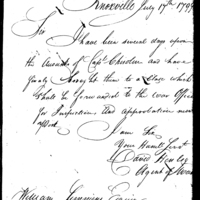
"Since the receipt of your letter of the 3rd instant, which did not come into my hands until the 11th, I have been making the necessary preparations. I have now the honor to inform you that I am in readiness and wait your orders."
This is Smith's reply to McHenry's Circular of 7/13/1799 in which he asked for the details of each officer's military service which would be used in settling their relative rank.
This is Hopkins' reply to McHenry's Circular of 7/13/1799 in which he asked for the details of each officer's military service which would be used in settling their relative rank.
John Kincaid has no immediate employment so it was suggested he see Captain Elliot about assisting with the erection of public buildings in Philadelphia. However, he was not interested and is returning to Carlisle.
Believes that Mr. Dana's claims about the proof of the pistol barrels is unnecessarily severe because the caliber of the pistol is smaller than the Charlottesville musket. Discusses size of proof balls. Warns that proofs were unfinished and barrels are rough when ordered which causes a reduction and weakening. Speculates about other reasons for miscalculations. The pistol making in Philadelphia is of smaller caliber than in Connecticut.
Certification of payment; $56.60 for retained rations and forage to Major Jeremiah Fisher of a Battalion of Militia Artillery ordered into service to suppress an insurrection in the Western Counties of Pennsylvania 1794.
Certification of payment; $11.40 for retained rations to Lieutenant William Huckell, in Captain Jonathan Carsons company, 1st Regiment Philadelphia Militia, commanded by Colonel Francis Gurney, ordered out to suppress an insurrection in the Western Counties of Pennsylvania 1794.
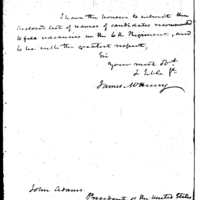
Submits an included list of names to fill officer vacancies in the 6th Regiment. The list contains recommended individuals for the posts of one captain, two first lieutenants, four second lieutenants, and one quartermaster, paymaster or adjutant.
McHenry discusses the situation in Europe and notes that negotiations between the Emperors of Germany and Prussia respecting preparations to meet the army of the Directory so as to extinquish their power in Italy and Switzerland. He discusses the Marquis de Lafayette who has the vanity to presume that he might become the instrument to reconcile the two hemispheres.
Mackey complains that there is such a habitual laziness of the poor in the county that it is difficult to procure workers for the canal. Nevertheless, one third of the canal has been dug.
Rann lists three accounts that will be closed on the books of the Treasury but Simmons is required to debit these accounts on his own books as may be appropriate. The three accounts belong to: John Bass, William Fulcher, and Isaac Miller.