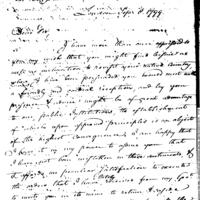
Expresses desire that he return to his native country to be welcomed openly. Requests his service in American military, particularly to command a military academy with the appointment of Inspector General of the United States.
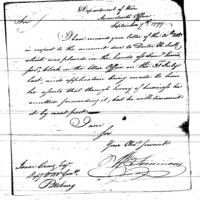
The Secretary of War has directed Lewis to enclose the bill of lading of two brass field pieces, six-pounders (condemned) for Hodgdon to take the measure of upon their arrival.
Notifies Adams that General James Wilkinson, lately in New York to discuss the affairs of the military in the west, is coming to Braintree to pay respects to Adams. Offers his opinion of Wilkinson, which he assures Adams will concur with that of Washington. Informs Adams of Wilkinson's fine service record, countering any opinion of Anthony Wayne by affirming that Wayne "was not his [Wilkinson's] friend." Praises Wilkinson, recommends him for promotion, and states that Wilkinson will be offended if he is not promoted. Concludes by saying that the hard things said by some about Wilkinson have never been proven.
Murray expresses his concern for Banger who ran away from death not realizing that, when commissioned to take him, death can run faster than he can. The citizens of Philadelphia seem to be flying in every direction to escape the yellow fever and he is happy that Hodgdon believes that their fears are groundless. The governor's sister is miserable because she has heard nothing from him (possibly Governor Sargent, Murray's brother-in-law?)
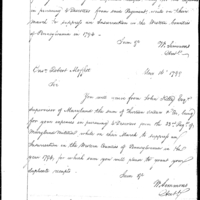
Swan has not disposed of the $4,000 and cannot provide Hodgdon with a draft.
In the final paragraph, Swan is referring to yellow fever, raging in Philadelphia. When as the rest of the department relocated to Trenton, Hodgdon took pride in the fact that he stayed behind, which Swan considered dangerous.
Routine correspondence concerning the appointment, transfer, promotion, discharge, desertion, leave, and assignment of individual officers and soldiers
Routine correspondence concerning the appointment, transfer, promotion, discharge, desertion, leave, and assignment of individual officers and soldiers
Routine correspondence concerning the appointment, transfer, promotion, discharge, desertion, leave, and assignment of individual officers and soldiers and concerning courts-martial and infractions of military discipline
"I received your favor of the 22d July and am pleased with the hopes of greater uniformity in the clothing in future. The Indians in this quarter seem much dissatisfied at the promises made them by the Secretary of War, that the Governor fo the Territory should be at Detroit in the course of the present summer to redress any complaints (many of which they have) which might be laid before him and attend to the equal and just distribution of their annual presents..."
Circular to the Commandants of Regiments: Hamilton warns of the ill effects of officers complaining in front of their men about the poor quality of articles furnished by the army. Such talk can only foster discontent among the troops. If there are complaints, they should be made by officers to their commandants who should then inform Hamilton of suggestions for improvements.