Annely informs Hodgdon that through the appoinment he got from the Secretary of the Treasury with the consent of the Secretary of War, he negotiated several contracts in Maryland that caused him some expense that he did not expect at the time. In the fall he will settle the notes with Mr. Taylor to his satisfaction. Annely recommends that the bearer of the letter be accepted into the army.
Routine correspondence concerning the appointment, transfer, promotion, discharge, desertion, leave, and assignment of individual officers and soldiers
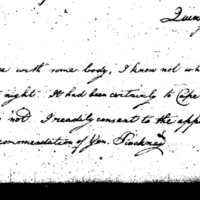
Approves Pinckney's recommendation of a man; expresses anger over the letter apparently being lost in the postal system [see McHenry to Adams, Sept. 21, 1799 for explanation].
"...Information from different regiments gives me to understand that my recommendations as to an advance in pay have not succeeded. As the troops are much discontented at the delay, it is my duty to renew the subject. And I must take the liberty to urge that by your interposition, forms may be dispensed with so at least as to effectuate an advance of two months pay upon account. The peculiarity of the situation of troops in the act of being raised is a good reason for departing from ordinary forms."
Routine correspondence recommending individuals for Army and Navy appointments AND routine instructions and correspondence concerning the organization of individual regiments.
Routine correspondence concerning the appointment, transfer, promotion, discharge, desertion, leave, and assignment of individual officers and soldiers.
Hamilton emphasizes that the troops must be paid promptly or many probems, including desertions, will resutl. The lack of musters or payrolls should not interfere with this goal. He notes that that the chief of each branch of the departments of supply and pay should have a deputy with each army or military district.
"Your letter of the sixth of this month has been delivered to me. I have no objection to the discharge of Sewal Moore if he will procure a good and substantial person in his place. With regard to the pay to which he supposes himself entitled, I would observe that it can not be advanced to him because, altho' he has served three months yet that service must be considered as merely a preparation for future and more important service. This last, in consequence of the discharge, will never be rendered to the US. You will take care that the business is so conducted as to involve no loss to the public."