Routine correspondence concerning the appointment, transfer, promotion, discharge, desertion, leave, and assignment of individual officers and soldiers.
Reviews the case of Hugh McAlister and the general practice for payments to those who apprehend deserters; points out that the regulation of this system depends on the construction of the governing resolution, the last resolution in the Appendix to the Articles of War. McHenry had asked that Simmons consult with the Treasury Comptroller on this issue, but notes that Simmons' previous reply did not expressly answer the question. McHenry is advocating a passage stating that soldiers _or_ citizens apprehending deserters shall be entitled to the advertised reward, as the current wording does not appear to mention civilians. Notes that Simmons' grounds for the rejection of McAlister's certificate were not stated in that rejection, and asks for an explanation.
Discusses the subject brought up by General Hamilton on whether it would be wise for parties of soldiers (or individual soldiers) who apprehend a deserter to be rewarded. Also mentions a citizen's complaint to President Adams that he had not been rewarded for turning in a deserter to a military officer.
McHenry has received a note from the Comptroller of the Treasury informing him that the accounts of Samuel Lewis on the books of the Treasury are settled and there is a balance due from him that will be transferred to the books of the Accountant [Simmons].
Morris observes that if the storekeeper is correct respecting the accuracy of the duplicate invoice, then either Morris cannot read or he cannot write and the truth is that he can do both. But since the invoice reflects the exact quantity of clothing received, it is not a matter of much moment. The coats and vests have not come perhaps because the materials may be sent in their stead. That would be satisfactory since there are enough tailors in the Company to make the coats and vests.
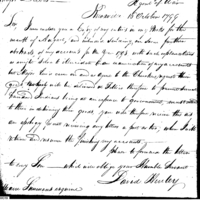
Encloses copies of books for August 1799. Intended to send other accounts, but Major Lewis demanded his attention as agent to the Cherokees. Lewis hopes to prevent Indians from becoming an expense to the government.
Routine correspondence concerning the appointment, transfer, promotion, discharge, desertion, leave, and assignment of individual officers and soldiers.