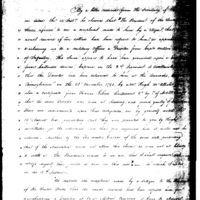
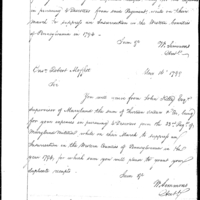
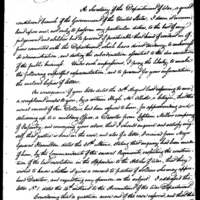
Simmons explains his actions in and view of the Hugh McAlister case, quoting McHenry's inquiry to him and then his reply -- in brief, that McAlister turned in a deserter, applied for compensation for this service, and was rejected on the grounds that the man he turned in could not be proven a deserter. States further that McAlister was a notary public at Carlise (where the return of the prisoner occurred), and was one of a number of people committing fraud against the United States by "presenting false power of attorney;" he reportedly affixed his signature and the U.S. seal to fraudulent documents. Says that while there is little documentation of these facts, he [Simmons] knows them to be true.
Simmons apologizes for misunderstanding of his last letter, and has consulted with the Comptroller, determining that McHenry's interpretation of the relevant passage in the Appendix to the Articles of War is correct. [The passage regarded the awarding of bounties for returned deserters to both civilians and soldiers]. States that he and Mr. Steele believe that the rejection of Hugh McAlister's certificate for payment was proper.
Hawkins disturbed by British conduct. Notes that by sending Bowles into the U.S. to meet with Indians, Great Britain is complicit in disturbing peace of the nation.
Hamilton discusses enlistment stategies, officers without commissions, stopping and examining boats on the Mississippi, and a suitable person to convey intelligence from Natchez to Knoxville.
Routine correspondence concerning the appointment, transfer, promotion, discharge, desertion, leave, and assignment of individual officers and soldiers.
Routine correspondence concerning the appointment, transfer, promotion, discharge, desertion, leave, and assignment of individual officers and soldiers.