Williams has received from Boston $1000 in post notes on account of the armory at Springfield. All letters from the southward directed to Springfield will, by an arrangement with the Postmaster General, be forwarded to the post office at Boston which will cause a delay of four days. Respecting the remittance of money this new arrangement will result in serious consequences and inconvenience.
McHenry agrees with Hamilton's assertion that public affairs are dangerous to one's reputation at present. On the whole, McHenry is happy to have resigned. He encloses a copy of a letter to his nephew which explains his reasons for resigning. McHenry plans to spend the summer at Lebanon.
Miller states that accounts which have passed through his hands will be found to contain nothing inconsistent with principles of justice and economy which have sanctioned admission of similar allowances.
Routine correspondence concerning the appointment, transfer, promotion, discharge, desertion, leave, and assignment of individual officers and soldiers.
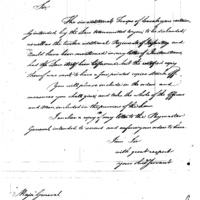
Hamilton informs Wilkinson that Congress has passed a law empowering the President to disband the Army except the four old Regiments of Infantry, the two old troops of Cavalry, the Corps of Artillerists and Engineers, and the staff.
Hamilton asserts his sense of urgency respecting the necessity of ensuring that the disbanded troops are paid what they are owed by the Deputy Paymaster Generals within Pinckney's district.
Certification of payment; $85 to Doctors Gillaspy and Strong, for medicine, advice, and attendance on sick belonging to Captain Gibbs detachment of 16th Regiment of Infantry, agreeably to report of Doctor William Shippen.
After examination of accounts submitted by Swan, Simmons noted that double rations are only allowed to officers commanding separate posts. In the case of Brig. Gen. Wilkerson, when he ceased to be commander in chief, he lost the privilege of double rations therefore a deduction from the accounts submitted was made. Secretary of War was written for a decision on the subject and his private opinion was stated that he thought the Brig. Gen. deserved double rations, however the Sec. of War never gave an official ruling on the Brig. Gen. situation. Simmons awaited a reply.
Treasurer to remit sum to Jackson for payment of Caleb Gibbs for mustering and inspecting a company at Castle Island under the command of Captain Samuel Gates. Payment was also for postage of letters pertaining to public service.
Acknowledges Caldwell's letter of resignation as chief clerk of the War Department. Expresses a wish that Caldwell would have suspended his decision until meeting McHenry's successor - Samuel Dexter. Notwithstanding this objection, McHenry accepts Caldwell's resignation.
Directs that Whelen purchase $1000 worth of items for use as presents to the Choctaw Indians. Whelen is to ask John Harris for advice on the items, and to deliver them to Harris once purchased.
A copy of McHenry's letter to his nephew sent to Hamilton which explains in detail his resignation as Secretary of War. In essence, President Adams forced his entire cabinet to resign believing them disloyal in an election year and not supportive of the mission to France.