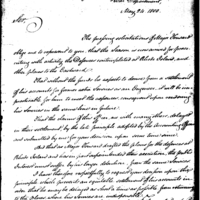
Agrees with McHenry and the other department heads on the need to appoint a person to inspect the garrisons, Indian trade houses, and general conditions of the U.S. frontiers. Asks for the names of candidates to be sent to him, and recommends a senator from Connecticut as one candidate.
States that to enable him to execute orders received from Secretary of War office, need sums of money. Discusses accounts of the recently deceased purveyor, Tench Francis.
Hamilton makes no distinction between special compensations to persons not of the army and similar compensations to officers of the army for services which do not appertain to the nature of their offices. Therefore, Capt. [Abraham] Ellery's expenditures have Hamilton's sanction.
Hamilton assures Adams that his personal regard for Col. [William S.] Smith produces sentiments very different from a disposition to throw the least impediment in the way of his success. The appointment of Col. Smith will violate no military rule nor the right of any other officer.
Blackburn was issued monies to pay troops at Fort Norfolk. Simmons requested accounts of money issued to the troops and any remaining sum or Blackburn must refund the United States the sum issued to him by the Treasurer.
Simmons received letter that contained current accounts and vouchers for Vischer. Monies to be paid to Vischer by Messr. Parker. Sum paid to Vischer by William Pentrip over and above the amount specified cannot be admitted to the debit of the U.S. Instructions regarding this sum was mailed previously in order to govern Vischer on the subject.
Messr. Lane and Satter charged on the books with 11,000 advanced for the manufacture and delivery of an iron cannon. Simmons hoped to close the account and requested vouchers, if vouchers couldn't be produced he requested an explanation.
McHenry mentions hearing a rumor that he had forced Stagg out of the position of Chief Clerk of the War Department to make way for McHenry's brother-in-law, and that he treated him badly in that office - asks Stagg whether he felt any such pressure or displeasure with McHenry's conduct.
Notes that there is a rumor floating around - which has reached the President - that McHenry encouraged Stagg to resign from his position as chief clerk of the War Department in order to create a job for his brother-in-law. Asks for Stagg to reveal the truth that he was not pressured to resign.
Responds to Adam's note of the previous day enclosing a letter from William S. Smith, Lieutenant Colonel of the 12th Regiment of Infantry. McHenry considers the legality, justice, and pridence of Smith's request for a special appointment and his own battalion.
Mentions that Major Tousard is now insisting on the need to finish fortifications in Rhode Island and other points eastward. Notes that Tousard, like many other officers, is owed back pay; also notes that his services in planning and beginning the defenses at Rhode Island were indispensable, and he is equally indispensable for their completion. Requests that Tousard's pay be expedited as quickly as possible.
Due to the military reductions that were occasioned by a new "democratic influence" in government, Major Craig offers sympathies to Samuel Hodgdon for being removed from office. Craig also expresses regret that Colonel Pickering was among those fired. Craig is referring to the ascension of Thomas Jefferson into the White House, along with the Democratic-Republicans in Congress - the opposition to the Federalist agenda. Jefferson was known for his opposition to a standing army.
Claude Pourcheresse has been employed by the public but has been dismissed. Byers believes he has conducted himself with fidelity. He and his family are returning to Philadelphia in hopes of finding employment in some form of public or private business. Byers views him as an object of compassion and hopes that he succeeds in procuring a livelihood.