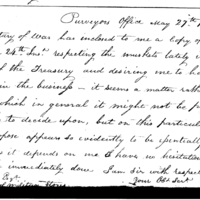
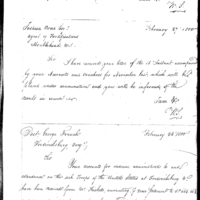
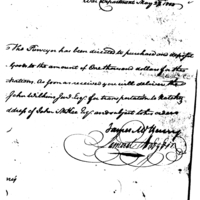
Whelen has received the letter respecting the muskets lately imported by the Secretary of the Treasury and requiring him to do what is necessary in the business. Whelen considers this kind of business out of his line but in this situation it seems so essentially necessary that he will comply with the request.
Rice addressed the current situation in Oxford as, "not dissimilar to our primitive New England fast days. I feel for many of my officers, they left lucrative & honorable employment. They can now neither return to them, nor place themselves in situations equally as eligible." Not believing in the orders to disband, he purchased a complete set of musical instruments. Now that his unit has been disbanded he has been told he is responsible for the cost of the instruments. He asks for advice on how to resolve this situation.
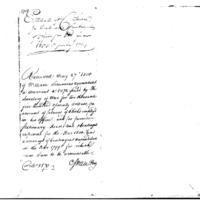
Swan receives warrant issued by Secretary of War for $2570 on account of salaries of clerks employed in his office, and for furniture, stationary, house rent and contingent expenses for year 1800, and arrearages of contingent expenses, 1799.
Routine correspondence concerning the appointment, transfer, promotion, discharge, desertion, leave, and assignment of individual officers and soldiers.
Hamilton asserts that it is very important in tactics to ascertain the proper length and speed of the step so he is causing experiments to be made in various quarters with this in mind.
Settlement of Johnathan Williams, provisional purveyor, yielded a credit to his account for his services rendered to military stores keeper, John Harris.
Mr. Stoddert, the new Secretary of War, has asked whether Hamilton or Gen. Pinckney has been directed by the President to thank the troops or say any clever things to them on announcing the order for their disbandment.
Requests that John Wilkinson, Quartermaster General, deliver suits of artillery clothing, swords, belts, and a flag to Charles Wollstonecraft, paymaster of the 2nd regiment.
For room furnished to Captain Ellery for 9 and 1/2 weeks. Hamilton asks that Ebenzer Stevens reimburse Captain Ellery. Ellery notes he received $38 as reimbursement.
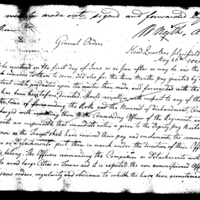
This General Order prescribes the date and manner in which troops are to be paid for the three months enlistment authorized by the Act of Congress and discusses the way in which pay is handled for those who are casualties of war. As soon as the troops have received their pay and emoluments, their commanding officers shall put them under march. The officers will endeavor to avoid marching through large cities or towns.
Informs Whelen that the 100 bags of saltpeter sent for refining into gunpowder were received, and that tests have been undertaken to see how much pure saltpeter may be gotten out of the unrefined substance.