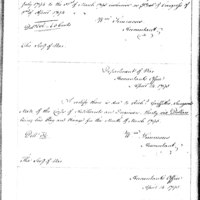
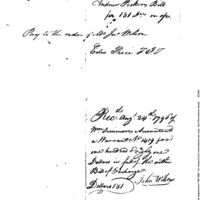
Hagner certifies that $30 is due James Triplett, Cadet of the Corps of Artillerists and Engineers, and the men under his command at Norfolk, Virginia being his and their pay for June 1796.
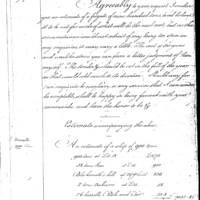
Contract for composition work has already been made; could have been done more cheaply at Philadelphia. Discusses the seasoning and salting of the frigate planks. Postpone journey to Norfolk until further instructions given.
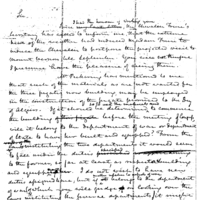
McHenry informs Washington that there are a surplus of materials from the construction of three frigates that can be used for the construction of a frigate promised to the Dey of Algiers. McHenry asks Washington whether the Department of War or the Department of State should oversee this process. McHenry concludes by updating Washington on the French victory in Sardinia.
Notifies Freeman of surgeon's mate Frederick Dalcho's power of attorney sending his pay to the War Department Accountant's office and notifies Freeman that Dalcho is ordered to Fort Johnston under the command of Capt. Kalteisen.
Notifies Kalteisen that surgeon's mate Frederick Dalcho will be under his command in Charleston but his pay will be retained in the War Department until further notice per Dalcho's power of attorney
Explains the reasons why Miller's recuiting account cannot be placed to Miller's credit on the War Department accountant's books. Speaks of a "premium" paid to soldiers who apprehend Army deserters
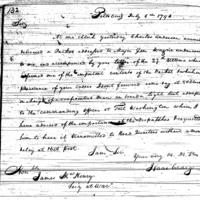
McHenry submits a list of candidates for appointment to officer vacancies in the 9th, 10th, 14th and 15th Infantry Regiments. Expresses doubts about the character and sobriety of one appointee, and asks that his appointment be withheld until more information on him can be gathered. Also mentions a Samuel Mackay, recommended by the Senate for a lieutenancy, but who has been recommended by others as more deserving of a captaincy.
Hodgdon is asked to examine a sample of cotton shirts and, if they are not suitable, describe how they are defective. Do these sample shirts provide durability equal to the linen shirts usually furnished the soldiery.
In addition to enclosing the returns of ordnance stores and clothing, Kateisen stresses the urgency of the need for coats, hats, vests, and linen overalls at Fort Johnston. The soldiers have nothing but rotten rags to wear during the hot weather and have responded with great murmering and discontent.