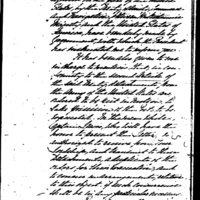
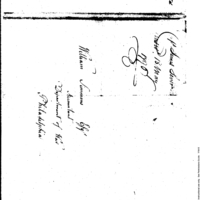
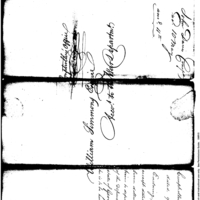
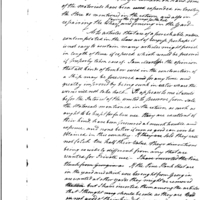
CITATION only. Simmons to Peyton 06/10/1796
[Discusses Peyton's account with the War Department, primarily his credits and balances for recruiting service. Discusses War Department policy for paying officer's recruiting "premiums" in the case of deserters and mentions bounties due to Army recruits.]
Major J. J. Ulrich Rivardi informs McHenry of a conflict between Col. Rochefontaine and his officers and strongly recommends a court of inquiry to investigate rather than a court martial, for the latter may lead to more publicity, more confusion, and more delays.
Ames will be glad to receive the money at the time proposed. He will defer leaving for Philadelphia since the money will probably arrive at the same time as he would leave home. The circumstances of the people to whom the money is due is such that it would be better to procrastinate than disappoint them.
Simmons certifies that $90 is due Michael G. Houdin for his pay as keeper of the ordnance and military stores at Albany from January through March 1796.
Discusses cannon for frigates constructed at Cecil Furnace. Have been proved and Mr Hughes wishes to have them examined and received by United States. Therefore,Truxton is asked to go to Cecil Furnace and examine cannon and determine if fit for service on frigate. Explains the terms of contract. If cannons are acceptable, make arrangements to transport to Baltimore and begin arrangements for construction of carriages.
Request to exam cannons cast at Cecil Furnace and take measurements for the construction of gun carriages. Noted contract stipulated that cannons should be delivered by Furnace upon proving and approval.
McHenry informs Schuyler that Captain Lewis, who is also delivering Schuyler this letter, is in possession of a dispatch relative to western posts in New York. Schuyler is instructed to send Lewis on the nearest and most convenient route to Quebec.
Captain Kalteisen discusses his many burdonsome responsibilities at Fort Johnson and advises Hodgdon that he has been sick and absent from his post so he cannot be blamed for any mistakes that were made.
Enclosed is the receipt of John Habersham for $7.50, applied by him to defray the incidental and contingent expenses of the War Department in the state of Georgia.
John Habersham, Collector of the Customs in Savannah, Georgia, is to be held accountable for the sum of $7.50, the amount he discounted from the monies arising from imposts and tonnage in pursuance of a warrant to be issued in his favor by the Secretary of War.
The Secretary of War requests, via Jones, a return of all the clothing on hand at Fort Washington and vicinity, to help determine what needs to be procured.
Swan pledges to be punctual in responding to Simmons' directions respecting the quarterly transmissions of his accounts and vouchers. He would have sent them sooner but the men who ply between Limestone and Gallipolis have the kind of reputation that prevents them from being charged with papers of importance.
Providing the return of the articles received into the naval yard; providing recommendations to prevent the sale or rot of unused materials. Talbot is in favor of retaining as much of the material as possible, believing that the price they might fetch if sold would not equal their worth or the initial expense.
Freeman received payment from Simmons delivered by Lieut. Lowell for the pay of the corps at West Point. Vouchers, accounts current, receipt rolls with receipts for subsistence transmitted by Freeman. Freeman awaited answer from Simmons regarding who to leave money to during his furlong.