Notifies Tousard that he has directed Captain Fleming to pay the "absentees." Discusses Lieutenant Geddes' advance, the pay of the Corps of Artillerist and Engineers, the proper keeping of muster rolls and pay rolls, including accounting for deserters, and the pay of the Army detachment under the command of Captain Bruff, including pay of the soldiers' "retained bounties"
Notifies Fleming that he will receive money from Nicholas Fish for pay of "the company" and the Corps of Artillerists and Engineers. Apologizes for the lack of a regular paymaster at West Point. Directs that "absentees" be paid and that "retained bounties" be paid to soldiers. Reports results of examination of pay rolls.
Notifies Fish that he will receive money from the U.S. Treasurer to reimburse George Fleming at West Point for the pay of several officers and for the pay of the Corps of Artillerists and Engineers at West Point
Acknowledges receipt of Craig's voucher and schedule of payment which are to be examined and credited. Notifies Craig that he will receive notes for the pay of the troops and discusses the need for the Army's pay to be no more than two months in arrears per act of Congress.
Information from Colonel Hamtramck on possible hostilities by Chipewa Indians. Wayne suggested the Chiefs should be approached to meet in council to discuss peace. Dragoons mentioned as good keepers of the peace if Indians were indeed hostile.
Murray again requests that McHenry answer a question from one of his constituents concerning bounty lands and certificates, particularly their value. The author also reports on his wife's improved health and expresses indignation at the emerging Democratic-Republicans. Murray concludes by announcing his consideration of retirement from public life.
Lewis received $3390.96 on account of pay, subsistence and forage of troops of upper parts of Ohio River. Promises to transmit to Isaac Craig at Pittsburg.
Cover letter for receipts from Donald G. Mitchell, Lieutenant Horatio R. Dayton, and George Fleming in the amounts listed. Cited in Simmons to Fish 06/27/1796
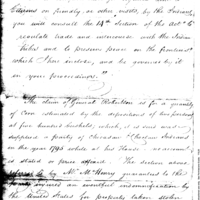
William Simmons addresses compensation for damage committed by Indians. He refers to the act to regulate trade and intercourse with Indian tribes and to preserve peace on the frontiers. Discusses claim by General Robertson for a quantity of corn claimed destroyed by Choctaw and Chickasaws at General Robertson's house. Simmons states that a deduction should be taken from annual amount given to the offending tribe. He goes on to argue that the corn was not stolen or destroyed; [it appears that the Indians ate the corn] therefore there cannot be a legitimate claim.
McHenry informs Byers that he has ordered the Commanding Officer at Tellico to put an immediate stop to the sale of spiritous liquors to the Indians. The Purveyor has received the skins and the goods for the trading house sent to Byers by the return wagons.
James McHenry informs the Governor of Tennessee that while he may call on the state militia for emergency defense of the frontier, he ultimately needs to notify the War Department and President on the circumstances surrounding the deployment of the militia and the numbers deemed necessary. No pay or remuneration for militia services can be authorized without the consent of Congress or the President.
Has sifted all powder that came from French in December 1795 and packed it into new barrels, and marked and renumbered as directed. Lists barrels and notations. Asks for credit for Mr. Miller's barrels.
CITATION only. Simmons to Miller 06/30/1796.
[Simmons will examine Miller's accounts and vouchers. Notifies Miller that George Fleming will give him the money for paying the "retained bounties" due to soldiers enlisted by Miller. The Secretary of War will write Miller in regards to his request to stay with the Army.]
Simmons certifies that $1,247.99 is due Nicholas Francis Martinon, being the balance of his account for compensation and expenses as Temporary Engineer for the fortification in North Carolina from April 1, 1794 to April 23, 1796.