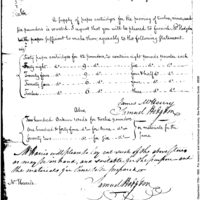
Discusses the claims of Captain John Pierce, Ensign Joseph Pierce, and Lieutenant John Stoers of the 15th Massachusetts Regiment in the Continental Army submitted by Foster for their possible grants of land.
Informs Kileltas that the claim of Mr. Ebenezer Woods for his services as a dragoon in Colonel Lee's Corps (Legion) in the Revolutionary War is inadmissible due an act of limitations passed by Congress barring claims for service before 1789
Certification that $206 is due Captain Joseph Elliot, Lieutenant Henry Muhlenberg, Surgeon's Mate William Steel (including forage) and the men under the command of Captain Elliot at Mud Island Fort, being their pay for February 1797.
Certification that $64 is due John Steel, Coxwain, and the men employed on board the public barge at Mud Island Fort, being his and their pay for February 1797.
Certification that $14.35 is due Lieutenant Richard Whiley of the Corps of Artillerists and Engineers, being the balance of his pay from December 20, 1796, the day of his acceptance, to February 28, 1797.
Certification that $45.09 is due John Lynch, Surgeons Mate in the Corps of Artillerists and Engineers, being his pay, subsistence, and forage for February 1797.
Certification that $183 is due Brigadier General James Wilkinson, being his pay, subsistence, and forage, and the subsistence for his waiters, for February 1797.
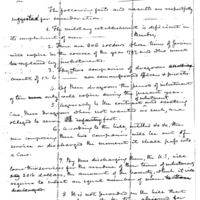
McHenry voices the opinion of the Washington administration to a bill in the House of Representatives that would reorganize the U.S. Army. McHenry argues that the bill would not allow the War Department to pay for the services of two companies of light-dragoons after they've been discharged, even though they'll still be serving in the interval. Most importantly, McHenry argues, some form of calvary on the western frontier is needed to preserve peace between the settlers and Indians, and it is "inconvenient and injurious" to discharge the dragoons.
Wolcott wants to know the supplies that will be required at each of the western posts so he requires information on the number of men stationed at each post and the number of rations (specifying whether salted or fresh) to be deposited in advance.
Captain Thompson is to inform naval constructor James Hackett that the freight of the frigate trunnails must be charged to his debit. Hackett should not object, since the trunnails are expected to arrive safely.
Discusses General Anthony Wayne's search of a foreign national; recommends searching Powers's boat and papers because there is reason to believe that he has been engaged in practices "highly injurious" to the United States.
McHenry argues for the absolute necessity of dragoons on the Indian frontier, contending that regulars are superior to militia in this regard. McHenry calls the military establishment "deficient" and reports that the time of service for 806 soldiers will expire after 1797. These "facts," McHenry argues, mean that the bill from May 1796 on dragoon companies must be revised or repealed. McHenry also reports that 500 American families are currently settled on Cherokee lands.