General Wilkinson writes for a supply of stationery. After comparing the returns in his possession, Hodgdon should provide information regarding what articles should be purchased and in what quantities. Niagara and Oswego have ordered their supply.
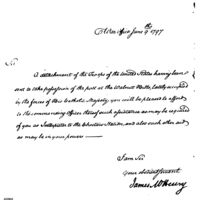
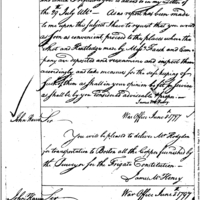
McHenry orders the recipient to provide his services as interpeter to the Choctaw nation to the Commanding Officer of the detachment sent to take possession of the post at Walnut Hills lately occupied by the forces of his Catholic Majesty.
It appears that Governor Gayoso is willing to demolish the Spanish posts on American land but he thinks he must continue his force in that quarter until the claims to land of Spanish subjects are reconciled. On the latter point, the Governor should be assured that no person shall be disturbed in his possession of property until they have had the opportunity to apply to Congress.
James McHenry writes General James Wilkinson on sending an officer to investigate an affair concerning the possible demolition of U.S. forts in Indian country and the claims of Spanish subjects to land in the region. Instructions outlined. Asks Wilkinson to report on situation, and to recommend the reinforcements and posture he sees necessary.
Frontispiece to an enclosed letter written to General Wilkinson; rationale being that the enclosed orders would affect Capt. Guion, who appears to have been posted to Fort Washington, but that the general might not receive them in time for them to be of use. Thus Guion is furnished with a copy of the letter to Wilkinson. Enclosed letter is Doc 1797060900201.
In this letter McKee requests 300 dollars in post notes from the Secretary at War. McKee justifies the funds as being necessary for "purchasing horses and paying my expenses here and on my action." To secure the reply, McKee suggests the answer be entrusted to the care of Messrs. Gardner & Mitchell of Savannah. Gardner and Mitchell will then forward the reply to Panton, Leslie and Company. This letter is marked as having been received and communicated to the President on 22 July 1797.
Notifies Henley that Ensign William Smith is carrying money due to General Sevier and his brigade for service in 1793 that was just authorized by Congress. Discusses Henley's estimate of military services in 1793; requests an abstract of payments made by Henley; discusses the pay of Mr. Smith, and informs Henley that Captain Sparks' recruiting accounts are under examination.
Harris is asked to deliver to Mr. Dowers, the sailmaker, two and a quarter gross, or nine pieces scarlet binding for binding the awnings of the frigate "United States."
Harris is asked to deliver to Mr. Dowers, the sailmaker, two and a quarter gross, or nine pieces scarlet, quality bindings for binding the awnings of the frigate "United States."
Harris is directed to deliver to Samuel Hodgdon, for transportation to Boston, all of the copper furnished by the purveyor for the frigate "Constitution."
Letter, Secretary at War directs Chapin to collect information regarding the disposition of Captain Brant. Letter marked "secret and confidential." McHenry desires to know to what extent Brant's alienation in Philadelphia, at the hands of the U.S. government, will cause him to abandon previous diplomatic positions.
Enclosed is Capt. Miller's recruiting account for 8 July 1796 to 28 March 1797 on which are shown the sums paid and the balance due each recruiter. Also shown is the bounty of five dollars paid to Joseph Blossom who has now had a discharge signed by Major Buell.
This is a cryptic message between St. Hilaire and McHenry that likely pertains to a covert shipment of arms and ammunition. St. Hilaire informs McHenry that legal prohibitions on the exportation of arms and ammunition are not troubling their business. St. Hilaire also asks McHenry not to put his name on the check sent for payment. St. Hilaire states that he has received information of dire consequences for the United States. Subsequently, St. Hilaire mentions commissions from "the Directory" being disposed of by General C. and the Duke of L.
Writing from Pensacola, John McKee informs James McHenry that the trading house of Panton, Leslie and Company have monopolized the Choctaw and Chickasaw trade but lost the Cherokee business. McKee discusses the role of trade in maintaining peace on the frontier and the role of the Spanish Court in granting Panton, Leslie and Company privileged access to Indian markets. McKee speculates that Panton, Leslie and Company might be inclined to continue its business under the authority of the United States. McKee proposes a plan for the U.S. to secure the markets and infrastructure of Panton, Leslie by assuming and disbursing their debts among the various U.S. agents and factors in the region. McKee opines that the likelihood of war with France makes his proposal necessary for the U.S. to secure native alliances via trade. But McKee also suggests an alternative plan. Following on a model used by the British, McKee suggests offering the Indians liquidation of their arrears to Panton, Leslie in return for a tract of land. This alternative proposal would disburse the debts of both Panton, Leslie and the Indians under more economical terms for the U.S. Government. McKee closes his letter by requesting that McHenry grant him powers to put these proposals into effect.