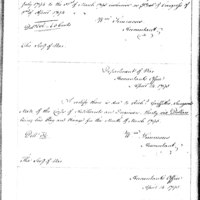
Notification that the amount of money Chester received in commissions on receiving and paying monies for the War Department will be entered on his account
Twelve suits of clothing for privates and twelve stands of arms and accoutrements should be transported by water to Sergeant Philip Williams at Wilmington, North Carolina. Williams belongs to McRee's company at Fort Johnston and the clothing and arms are for the recruiting service.
Two brass six-pounders, one three-pounder, and one five-and-a- half-inch howitzer should be forwarded to Tennessee complete for service. Except for the powder which may be furnished at Knoxville, McHenry approves of the quantity and quality of the several articles of military stores so Hodgdon can make the necessary arrangements for transportation as he sees fit.
The requested powder has been ready for some time. As soon as Miller's team returns from Jersey the powder will be delivered. It is fine powder that must be proved. Miller will not make common powder for Hodgdon until some other mode has been found to prove it.
Certification that $127.50 is due Michael G. Houdin, Military Storekeeper at Albany, being his salary from April through June 1797. Sum payable to Samuel Hodgdon.
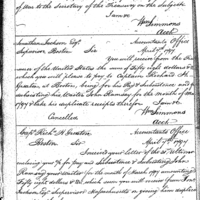
Advises Read that he will receive money from the Treasurer of the U. S. that he is to transfer to Sergeant Philip Williams in the specified amounts for the reasons he explains, including the pay of Sergeant Williams and the men under his command at Fort Johnston. Mentions money for the recruiting service.
Acknowledges receipt of receipt roll that will be credited on the books of the War Department accountants office. Acknowledges receipt of muster and pay rolls. Money for the pay will be forwarded by Edward Carrington, federal supervisor. Cited in Saunders to Simmons, 08/02/1797.
Advises Carrington that he will receive money from the Treasurer of the U. S. that he is to pay to Captain Richard S. Blackburn his pay and the pay of his men at Fort Norfolk and bounty for recruits, pay and forage due David Patteson, surgeon's mate
Directs payment to Corporal Moses and John Day for their expenses in pursuit of deserters. Simmons answers a question from Lieutenant Nehemiah Freeman regards accounting procedures for pursuit of deserters. Simmons notes that Freeman should be governed by Simmons' letters on that subject and by doing so will have their weight on examination of the accounts here. Simmons mentions the printing of advertisements for deserters, which Freeman should pay out of unappropriated monies.
Certification that $53.81 is due David Patterson, Surgeon's Mate in the Corps of Artillerists and Engineers stationed at Fort Norfolk, Virginia being the balance of his pay and forage from March 27, the day he accepted his appointment, to June 30, 1797.
Certification that $179.99 is due Lieutenant Philip Landais of the Corps of Artillerists and Engineers, being his pay as a cadet from October 1796 through February 1797 and his pay and subsistence as a lieutenant from March through June 1797.
Notifies Williams that he will receive money for his pay and that of his detachment, as well as for the recruiting service and several other sums. Cited in Williams to Simmons, 09/02/1797.
Certification that the appropriate portion of $35.27 is due the estates of the following soldiers: Pvt. James Williams of Capt. Griffith McRea's Company, Pvt. William Williams, and Pvt. William Johnson under the command of Sgt. Philip Williams at Fort Johnston.
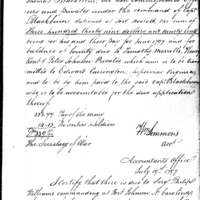
Certification of payment: $36 is due Sgt. Philip Williams, commanding at Fort Johnson North Carolina, being the amount of the bounty paid by him to three recruits and the premium for enlisting them. To be transferred James Read Esquire, Collector, Wilmington North Carolina
Numerous certifications of pay due, to include certification that $339.90 is due Capt. Richard Blackburn, Lts. John Saunders and James Triplett, Cadets Peter Lamkin and Thomas Blackburn, and the men under Capt. Blackburn's command at Fort Norfolk, being his and their pay for June 1797 and the balance of bounty due Pvts. Timothy Merrills, Henry Kent, and Peter Johnson.
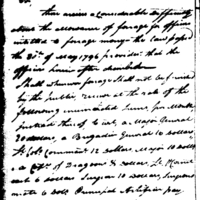
Discusses the laws and regulations surrounding the issue of officers' forage being paid for by the public. Lists the per-month sums allowed to officers of different ranks for forage, or in cash.