Reardon acknowledges that he has voluntarily enlisted to serve one year in the Marine Service, unless sooner discharged, according to the Act passed July 1st 1797 which provides a Naval Armament. The rules and articles of the Navy against mutiny and desertion have been read to him and he will be paid six dollars per month.
In compliance with the order of the Secretary of War, Mitchell has delivered to Hodgdon three brass three-pounders with their garrison carriages and implements, including two rammers with sponges and two worms.
Capt. Morris has paid the discharged men from the unappropriated money in his hands, leaving a balance in the favor of the United States of $15.89. Copies of their discharges are being transmitted.
Peter Larkins apparently was discharged due to disability by General Wayne. He says that his sickness is due to the hardships of wading across rivers even though Capt. Miller examined him and found him fit for service. Larkin said he was discharged at the age of 50 when in fact he was only 41. He has been paid five dollars for enlisting but Miller will await orders before proceeding with the case.
Thompson is waiting on the carved wood to complete the frigate Crescent. J. Hackett responsible for its construction and completion, agreeable to his contract. Nothing has been neglected in the navy yard.
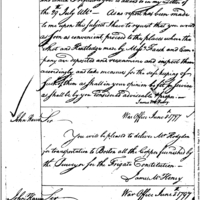
Secretary of War James McHenry has written naval agent Henry Jackson with approval for procuring fire engines for frigate Constitution from Boston. Fox explains the matter of procuring fire engines for frigate Constitution; provides Captain Nicholson with a copy of his correspondence of 29 July 1797 with the Purveyor of Public Supplies, Tench Francis.
Discusses fire engines for the frigate Constitution. Mr. Tench Francis attempted to purchase from Philadelphia without success. Captain Nicholson reports that Mr. Thayer of Boston makes quality fire engines. Therefore, Naval Agent Jackson ordered to make purchase from Thayer, under inspection from Captain Nicholson.
Frigate Constitution requires two fire engines, McHenry requested Mr. Thayer of Boston construct the fire engines under the inspection of Captain Nicholson.
Refers to an act 27 June 1897, authorizing the organization and supply of a militia detachment. Notes the President's support. Such militia should be ready to march at a moment's notice. The President authorizes the need for cavalry
Repeats instructions that the detachment of [several companies of] the 3rd Regiment in Tennessee immediately reinforce him at Massac, along the Ohio River. Complains about the leeway McHenry has given Butler (the 3rd Regiment's commander) to release the detachment only if it is safe to do so, claiming he cannot maintain peace on the frontier without the asked-for companies. Asks McHenry to order the companies to join him.