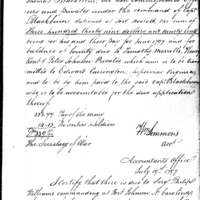
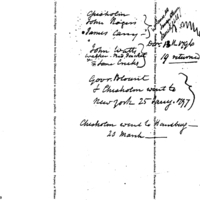
Certification that $39.29 is due Boyd Vaughan, Clerk of the Navy Yard at Philadelphia, being the balance of his salary from November 11, the date of his appointment, to December 31, 1797.
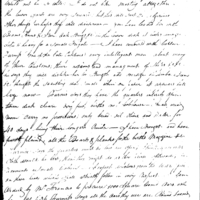
Transcribes a discussion between a Chickasaw chief and American. The chief insists that his people are aware that whites will stop at nothing to take their lands and reminds the American that they remember the terms of past treaties. The Chickasaw then says that he has been informed by Spanish Louisiana Governo Gayoso that Americans want to take possession of their lands and demands an answer to that allegation.
Extract of General Orders dated July 10, 1797, Detroit. It refers to a letter of Caleb Swan in which he asserts that the regimental paymasters refuse to render him their accounts for settlement as has been the accustomed rule. The paymasters are directed to settle their accounts with Swan immediately.
Encloses letter to Mr. J. Mentions the Mr. Scolten, brother of a friend who acts as the Danish legislative secretary. Requests meeting with young friend John W. Henry. European reactions to Congress. Sends greetings to Mr. Caldwell, Mr. Hindman, and Mr. Smith of Charlestown.
Acting in the absense of the Secretary of the Treasury, Comptroller Steele explains the process by which contracts are awarded and recommends that the United States by divided into three sections with a contractor assigned to each.
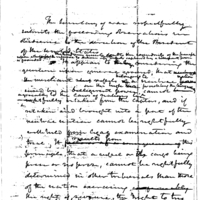
Discusses rules of engagement between a neutral vessel and a belligerent power. Questions whether or not a neutral vessel has a right resist - by force - a search of their ship, or if a belligerent power has a right to search a neutral ship and carry the vessel back to their country for a trial. McHenry adds that the United States has no obligation to return deserters from British vessels, and fully condemns impressment.
Discusses rules of engagement between a neutral vessel and a belligerent power. Questions whether or not a neutral vessel has a right resist - by force - a search of their ship, or if a belligerent power has a right to search a neutral ship and carry the vessel back to their country for a trial. McHenry adds that the United States has no obligation to return deserters from British vessels, and fully condemns impressment.
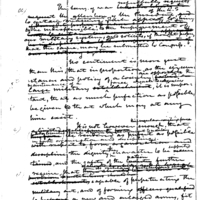
Requests the attention of the President and Congress to be directed to - what he considers - much-needed improvements in the military. Notes that this is difficult due to the country's resistance to maintaining a large military establishment. Insists that the military needs more organization and discipline, and scolds those who are opposed to an enlarged military. Compares it to a shepherd enclosing his fields from outside danger.
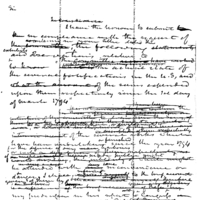
McHenry reports on the state of fortifications in the United States and the sum expended on them since 1794. Suggests that Americans are uneasy about maintaining a large military establishment, but insists that fortifications are absolutely essential to the defense of the United States.
Inquires on the numbers of troops needed in order to properly defend coastal forts and garrisons in the event of an invasion. McHenry asks what the House plans to do in order to adequately provide this need; he also seriously questions the ability of a voluntarily militia to do the job.
McHenry considers the possibility that French colonists in the West Indies will begin demanding from their mother country that freer and more liberal trade with the United States be allowed. McHenry then contemplates how this development would play out with Charles Cotesworth Pinckney - the U.S. Minister to France - involved, who McHenry claims has neither the authority nor instruction to improve the situation.
McHenry acknowledges a significant debate in the House over whether a proposed addition to the military establishment be necessary. McHenry stands by his position that not only should the military force on the frontier not be diminished, but it must be augmented. McHenry discusses the constant encroachment on behalf of whites on Indian lands, arguing that even an imperfect peace cannot be maintained - due to murders between the two groups - without a permanent military force on the frontier. McHenry also urges better upkeep of the fortifications on the Atlantic seaboard.