Bailey acknowledges that he has voluntarily enlisted to serve one year in the Marine Service, unless sooner discharged, according to the Act passed July 1st 1797 which provides a Naval Armament. The rules and articles of the Navy against mutiny and desertion have been read to him and he will be paid six dollars per month.
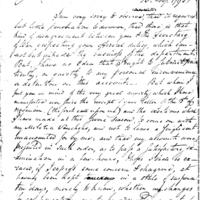
Blake hopes that Hodgdon spares him the disgrace of returning the small draft in question. If Hodgdon thinks it proper to discharge it, Blake will hold himself obligated to remit the same amount with interest and damages in case Colonel Sargent does not sanction the measure.
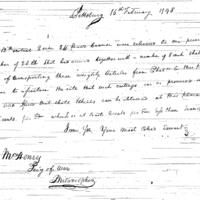
So many of the gun stocks on hand are unfit for use that replacements should be sent from either New York or Philadelphia at the earliest opportunity. There are no seasoned ones currently in Springfield. The remainder of the iron should be sent from Hartford by water as soon as the river opens. It should be of the thin kind since a great proportion of that on hand is the thick kind.
Butler has been told that she should apply for the price of the horses that were lost in 1797. Even though the value of the two horses is not high, she still wants to have the money refunded and asks Hodgdon about the proper procedure for obtaining the money.
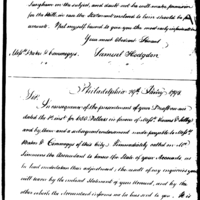
Wilkins has been advised by Mr. Ernest of the bill mentioned in Hodgdon's letter. Harrison has been charged with the bill in favor of Colonel Sargent. Bills have also been drawn for John Cunningham and Thomas Coffin.
Major Craig informs Samuel Hodgdon that cannons are received and indian goods are to be immediately sent forward. Craig also asks how various qualities of gun powder can be determined without opening the casks.
Heth states his concern and chagrin at having been kept in a state of suspense for ten days merely to ascertain whether or not his charges for compensation are to be admitted.
Miller enclosed receipts, receipt rolls, muster and pay rolls. Miller requested Simmons to disclose the status of Lieut. Daniel Bissell as an officer (or not).