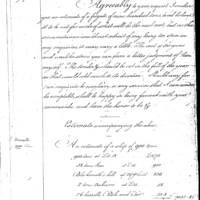
Regarding request for kentledge. Suggests that it may be more than needed by comparing amounts required of Captain John Barry and Captain Truxton. Too much ballast endangers safety of ship. Masts could be endangered by rolling. Discusses use of shingle ballast as an alternative.
Godfrey acknowledges that he has voluntarily enlisted to serve one year in the Marine Service, unless sooner discharged, according to the Act passed July 1st 1797 which provides a Naval Armament. The rules and articles of the Navy against mutiny and desertion have been read to him and he will be paid six dollars per month.
Craig strongly recommends obtaining a patent in the name of the President of the United States for lots No. 37 and 38 in the town of Waterford. Since all the lots in that town are subject to forfeiture if certain buildings are not erected prior to August 17th, application must be made to the Pennsylvania legislature that these lots be exempted from that condition of improvement.
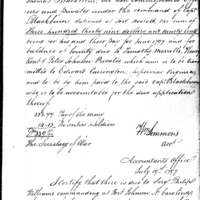
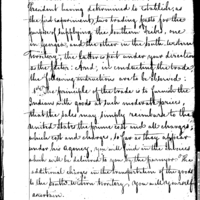
Letters between governor and Hawkins outlined and numbered. Hawkins recounted an ambush of U.S. officers, and complaints of white neighbors of Tuskeegee Tustunnagau and other Creek Indians. Tuskeegee put to death after civil trial. Blacksmith's employed by U.S. for the use of the Creek Indians, Hawkins requests ruling on the responsibility of payment.
Certification that $63.25 is due Ensign Henry Bowyer of the 4th Regiment, being for his pay and subsistence from December 1, 1797 to January 27, 1798, the date of his resignation.
Certification that $28.26 is due Private John Dutch, late of Captain Jonathan Haskell's Company 2nd Sub Legion, being his pay from August 1, 1793 to May 13, 1794, the time of his discharge.
Certification that $375.22 is due Sergeant Prince Bryant, late of Captain Dembler's company of Artillerists and Engineers, being his pay from November 21, 1796 to September 18, 1797, the date of his discharge.
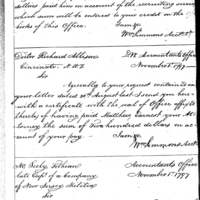
William Simmons informs Major Craig that the Accountant's Office has received his current account. Simmons also encloses a letter received at the Accountant's Office from Lt. Grayson.
McHenry expresses regret over Byers' intention to retire. He discusses the training that will be required for Byers' replacement. The inventory of effects must be taken in his presence and sworn to by him and Byers.
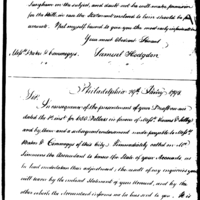
Wilkinson mentions requisitions for the Army, and promises his frank opinion on the insubordination and discipline of the troops in a future letter. Reply from McHenry surmises that Wilkinson should come to Philadelphia to report on these matters, but to avoid doing so until McHenry has collected and weighed the information available. Appears to address the reformation of regulations on these matters.
Lowndes, Templeman, and Stoddert warn that the bridge may not be safe due to the need for additional work. The only available means of financing the work will be for the stockholders to advance fifteen dollars for each share. This is essential because, without the work, the bridge may be dangerous to use.
William Simmons informs William Polk that he is not considered to be entitled to land because his eligibility as a deranged officer remains in question.