Among other matters, Mrs. Murray complains that a large number of her subscribers are astonishingly remiss even while she is obligated to make payments to her printer. A letter she received from Richmond, Virginia informed her that the "excessive praise" she has lavished upon the President will prevent the sale of her books in that part of the country. Yet, she insists that time and perserverance will conduct her through the vexatious labrynth and she will be able to discharge her bills.
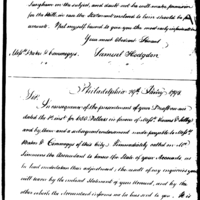
Wilkins asks Hodgdon to purchase two quarter-casks of sherry wine from Mr. Hager. Hager's is of particular kind purchased by Colonel Nevill and should be forwarded to Isaac Craig in Pittsburgh and charged to Wilkins.
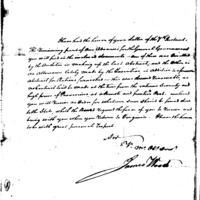
Wood requests that John Dawson be paid whatever sum may be found due to the State of Virginia for advances made for and on account of the General Government.
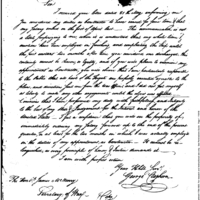
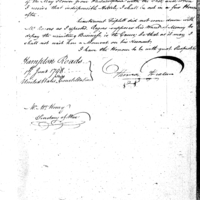
Claghorne received the letter of McHenry, the Secretary of War, informing him that his duties as a contractor have ceased for some some time and that his salary had ended on April 1st. Claghorne points out that he was directed to complete a frigate to all specifications, and that he did not feel himself at liberty to make any other agreements until the work was completed. Claghorne wishes for his efforts to be recognized and thus his salary carried forward until the end of the current quarter, or at least for the two months in which he has actually been employed.
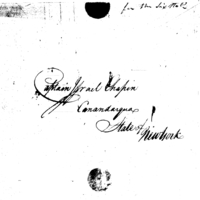
Enclosed is a Bill of Lading for sundry articles to be shipped to Michael Houdin at Albany and by him transported to Israel Chapin for the use of the Six Nations of Indians as their annual annuity.
Harris is directed to deliver to Purveyor Tench Francis all the checks now in the store, to be paid for by him at just valuation, for the use of the Navy.
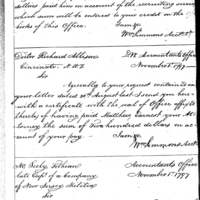
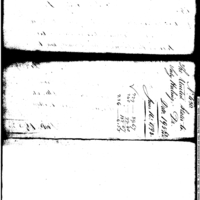
Receipt for services of Dr Seely Huling. Transportation of coils of ropes for vessel on Lake Erie; hospital stores for troops on Mississippi; transportation of Major Cushing's trunk and box. In note below, Huling received $195.62 from Samuel Hodgdon.
Enclosed are receipts for payments made by Capt. Morris to his company. Receipt rolls for payments made by Mr. Guimpie in Morris's absense are also enclosed. Men who have been discharged with arrears of pay due them have been given due bills by Capt. Morris.