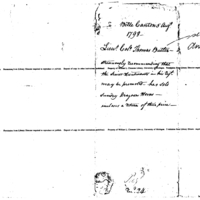
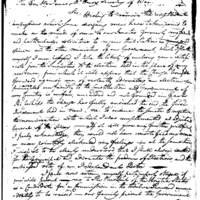
Lieutenant Colonel Butler observes that by a law a regiment is to consist of ten companies, and assumes that the Senior Lieutenants now in his regiment will receive the command of those companies, otherwise causing discontent. Butler adds that he has detached two officers on recruiting service, including one to Kentucky. Butler concludes by stating that he has ordered seven disordered cavalry horses to be sold, along with fourteen pack horses, in exchange for corn for the troops - the information for which he encloses.
Mills has offered himself to the President and the Secretary of War for a commission in the Army. He asks Hodgdon to attest to his character and provide whatever recommendation he thinks Mills deserves. He believes his long service as a captain in the Revolutionary War should entitle him to a majority.
Captain Bryant has mentioned the propriety of cleaning the French arms in the stores and it would be more convenient to do it now rather than later. Colonel Larett [?] from Plymouth County has offered to buy the barrels condemned during the proving by Mr. Nicholson. Since they are useless and will soon be covered with rust, they should be sold along with the refuse bayonets and rods. They could fetch as much as $200 for the public.
Smith denies the charges brought against him of violently advocating an election upon principles unfriendly to the Constitution which he fears may cause the Senate to reject his nomination as Adjustant General of the Army. He asks McHenry to present him to the President as a candidate for a commission in the twelve thousand being raised.
Smith, American Minister to Portugal, reports to the Secretary of State on the news from Lisbon, especially that which relates to the ongoing quasi-war with France.
Clothing and muskets have been sent to Capt. Bishop's address and a receipt should be given to the bearer confirming that the packages were delivered entire and agreed with the invoice.
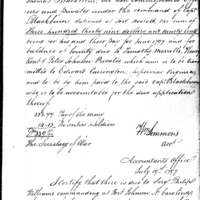
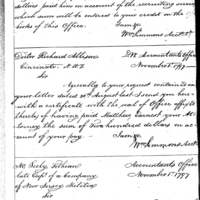
Certification that sixty dollars is due Lieutenant Ferdinand L. Claiborne of the 1st Regiment, being his pay as Quartermaster for May through October 1796 in addition to his pay as Adjutant.
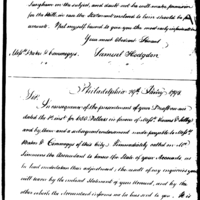
Certification that $412.14 is due two detachments at Fort McHenry under the command of Captain Staats Morris, being for the pay and subsistence of Lieutenants Philip Landais and Samuel Dyson, and the non-commissioned officers and privates for July 1798.
Certification that $72 is due William Littlefield, Captain in the 1st Regiment of Artillerists and Engineers, being for bounties paid and premium allowed him for reenlisting four soldiers.
McHenry states that the provisions for raising the 12 new regiments of infantry will be too time-consuming if orchestrated from one central location; proposes that 3 districts be created for this purpose. Adams (with the help of Generals Knox and Brooks) will handle New England; McHenry will take care of the states between New York and Maryland, and Washington will take care of Virginia and all states south. Anticipates the raising of 4 regiments in each district. Proposes officers for regimental command. Asks permission to delegate some responsibilities to General Knox and the Inspector General among the myriad tasks of organizing, equipping and regulating all the new troops. Relates that he is pressing for the production of new muskets at Springfield as quickly as possible; for now he recommends that government muskets be kept for federal use, and not loaned out to volunteer companies. Also notes that a large outbreak of yellow fever has occurred in Philadelphia, and anticipates the removal of the public offices to Trenton.