Mentioned previous letter sent by Washington to McHenry regarding lack of communication to Washington on all military decisions. Thanked McHenry for his inclusion in more recent decisions. Noted Mr. Talmadge's positive opinion of the cavalry. Inquiry into obtaining tin box from a friend in the East India Company.
Certification that $44 is due Pvt. John Lowry, late of Captain Solomon Van Rensselaer' s Troop of Dragoons, being his pay from 1 June to 1 December 1795.
Certification that $6.96 is due James Bennet, late a private in Captain George Ingersoll's Company in the Corps of Artillerists and Engineers, being his pay from 1 November to 25 December 1797, the day of his death, which sum is to be paid to his widow, Mary Bennet.
Refers to the cessation of treaty negotiations with the Cherokee, which took place in July 1798. Peace in Tennessee said to be contingent upon these negotiations' success. Discusses the various issues a treaty should consider, which seem to include the issue of white intruders on Indian land. Stresses the imperative of re-opening negotiations. Says that a "talk" to the Cherokee from the president might smooth the way; attaches a form for such a talk, that the president may review and sign it [not included]. Mentions that John Steele [secretary of Mississippi Territory?] has vacated his position as Indian commissioner, recommends a Col. Butler in his place.
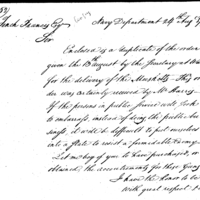
The Secretary at War authorizes the transfer of 700 of "the worst of the old muskets now in store" to the Navy, to be valued by Mr. Nicholson and charged to Tench Francis, purveyor. On the same document is a note from Benjamin Stoddert Secretary of Navy expressing irritation as to why there is difficulty on delivering the guns to Tench Francis Purveyor.
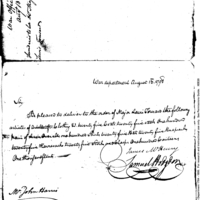
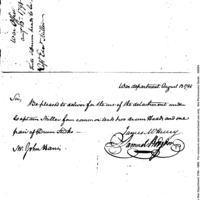
Harris is asked to deliver to the Secretary of the Navy one marquee complete, four horseman's tents, and twenty five common tents to be returned or paid for at fair value.
Harris is asked to deliver seven hundred of the worst of the old muskets now in store to the Secretary of the Navy so that they can be valued by Mr. Nicholson and charged to Tench Francis, Purveyor.
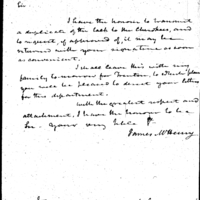
Forwards a document ["talk"?] concerning the Cherokees [not included], asking for Adams' signature on it. Notifies Adams that he is moving his family out of Philadelphia to Trenton to avoid yellow fever at the former.
McHenry notes that he has had to leave Philadelphia for reasons of health, but inquires as to Hamilton's response to General Knox's letter regarding the relative seniority of Major Generals in the Provisional Army,.