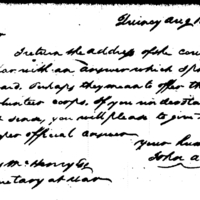
Forwards an address from the Rensselaer County, New York militia, as well as his response to them. Seems to have found their address unclear; asks McHenry if he can discern whether the militia meant to offer themselves as a volunteer corps. If that is the case, Adams, directs McHenry to send them an appropriate official response.
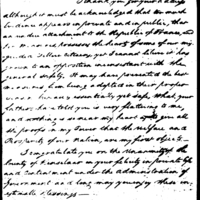
Thanks a group of New York militiamen for their praise; assures them that he has the safety and interests of the country as his first priority. Thanks their county, Rensselaer, for its wholehearted commitment to the government. Mentions undue attachment to France.
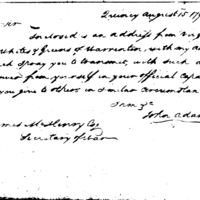
Adams forwards an address from people at Warrenton, Virginia [perhaps a militia unit, the Whites and Greens], as well as his response; asks that McHenry add his own response and transmit all to Warrenton [the enclosures are not included].
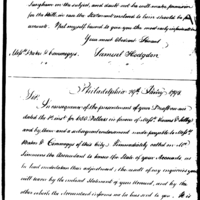
Along with his concern that the Sloop "Sally" sailed without the letter specifying the destination of the stores, Hodgdon notes that all the public offices have been removed from Philadelphia because of the threat of contagion. He remains because he believes the threat is exaggerated.
Hodgdon points out that the same freight allowed Capt. German to South Carolina must also be allowed Capt. Gildea. As bills are paid in gross sums, Hodgdon cannot ascertain for certain the specific charges for each article.
Among various supply matters, Hodgdon notes that the Secretary of War has gone to Trenton with the other Secretaries because of the threat of contagion. He has reminded the Secretary that work of an extensive nature cannot be carried on without money,.
Hodgdon discusses the dangers to the public stores due to the deserted state of the city resulting from the outbreak of yellow fever. He considers the threat from France much greater than that from the fever.
Because of inaccuracies in the return of the former Quartermaster, Hodgdon requests clarification relative to the true state of the public stores of the garrison at Niagara
Amidst a discussion of other matters, Ames notes that he needs more assistant armorers who understand the mechanical arts, have respect for economy and industry, and have good morals. Mr. Forbes has been recommended by Reed. Lyman would be sure to give satisfaction to the public and Mr. Perkins has also been mentioned as a possible applicant.
Having heard that the President may establish an arsenal at Carlisle, Gregg recommends Joseph Edmiston for the position of Superintendent of that facility. Edmiston is a man of some property, can provide security to any reasonable amount, and is liable to no objection escept that he is perhaps too much tinctured with Federalism. Gregg also inquires about Hodgdon's opinion of George Armstrong who has applied for a subaltern's position.
Gates affirms receipt of the packages sent by the schooner "John." He finds them in good order and agreeable to the invoice but was disapponted not to find clothing for the drummer and fifer who have enlisted.
Adams weighs in on Knox's complaint of the ranking of Major Generals for the Provisional Army, arguing that Knox should indeed rank next to Washington, with Pinckney and Hamilton below him. Until questions of rank are settled, Adams is of the opinion that no other general officers should be called into service. Also reaffirms Washington's right to appoint all his aids and secretaries.
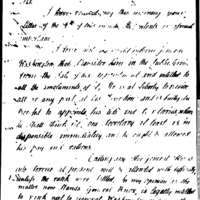
Asks that McHenry inform George Washington that he is considered fully in the public service, may appoint aides and secretaries as he sees fit, and may draw upon pay and rations. Asks that General Knox be called into service if Washington believes it proper to do so. Considers whom shall rank whom among general officers, the order being Washington, Knox, Pinckney, and Hamilton. Authorizes McHenry to call up Hamilton as well, whenever seems best; assures McHenry that the New England states may be counted upon, and will not stand further [French] depredations [presumably this is Adams' answer to McHenry's idea that Adams take a hand in raising troops in that district].
Enclosed is a list of Invalid Pensioners for the State of Pennsylvania with a warrant for their payment for the period from March 5th to September 4th, 1798. The Secretary of the Treasury will provide the funds to make these payments.
James McHenry and Samuel Hodgdon request that John Harris deliver to the Secretary of Navy, a marquee, horseman's tents and common tents, to be be paid at full market value. Commandant of Marine Corps William Ward Burrows requests delivery of tents to Lieutenant George Meminger.
Freeman anxious due to "clamorous" militia who have not been paid. Simmons could not pay soldiers. Extract from letter by Col. Fauche to Freeman to described injury to character sustained by Fauche due to the lack of pay given to soldiers under his command in Georgia.