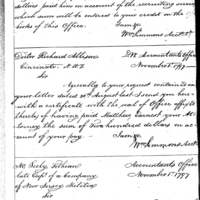
Certification that $240 is due Captain Richard H. Greaton of the 2nd US Regiment, being the amount relinquished out of his monthly pay from 1 December 1797 to 31 July 1798, the day the relinquishment expired.
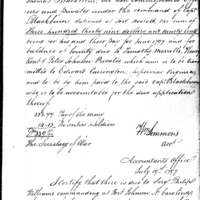
Certification that $747.49 is due a detachment of the 1st Regiment of Artillerists and Engineers, being for the pay and forage of the commissioned officers and the pay of the non-commissioned officers and privates for July 1798, including the pay of two discharged men and retained bounty due six recruits.
Extract:
Secretary of War noted he received plans for defense construction on Governor's Island and would submit the plans of Mr Mangin and Mr. Fleming & Hills to the Military Committee of New York for approval.
Browne acknowledges receipt of two sticks of port-fire and fifteen four-pound flannel cartridges to prime cannon at the Eagle Furnace agreeable to an order of the War Office.
Among other matters, Hamilton expresses dismay at General Knox's negative response to his subordination to Hamilton in the Provisional Army and voices his gratitude at Washington's continued support during the ongoing controversy.
Letter, discusses contract for manufacture of muskets. Directs issue of 3,000 musket stocks to Robert McCormick, arms contractor. Asks that the two best of the finished muskets, being made on the Charleville French model, be kept as patterns, with one to be returned to McCormick, one to be kept in the military stores.
Sargent asks for numerous supplies, including large quantities of wine, coffee, and brandy, which he must have before winter and without which he will absolutely suffer. He has asked for permission to visit the Atlantic states the following summer if the Mississippi territory is at peace and he has organized its government well.
Writing in his usual code, Sargent requests two quarter casks of good wine to be sent by way of Orleans and two more quarters of red or white should be added, he does not care which.
Wilson is so unwell that he is unable to attend to business and asks Hodgdon if he can retire from Philadelphia. The prevailing sickness is spreading rapidly and his state of mind relative to staying is such that it is prudent for him to leave. He asked for a leave of absence the previous year and, though Hodgdon anticipated no danger and intended to stay, he allowed those who were afraid to depart.
Due to obligations to his family and his present pursuits, Clarkson declines any appointment in the Provisional Army and expresses doubt that there will even be a need for serious military operations in the United States.
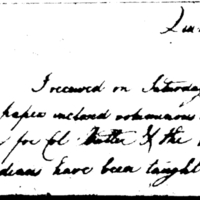
Acknowledges receipt of McHenry's letters concerning treaty negotiations with the Cherokee. He confirms the commission of Col. Butler as an Indian commissioner, and comments on the root of the problem: "The Indians have been taught to misunderstand the advice against selling their land to individuals, for advice against selling to the United States."
Speaks of [illegible name] who serves the government, particularly in South Carolina, with an appointment in the provisional army. Left Philadelphia to discuss matters with generals in the Pennsylvania Army. Refers to David Knowles and the Cherokees. Details communications and plans with various officers. Mentions infantry uniforms and arms for various companies. Lists Wilmington District names (many illegible).
This letter recommends Jeremiah Clapp for a position in the U.S. Army. Major Clapp was in the First Brigade of 3d Division Massachusetts Militia and has conducted with great military propriety in that office. He has natural genius and talent. Baldwin vouches for Clapp's federalist political credentials; he is strong supporter of the government and the constitution.
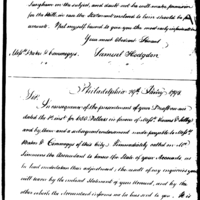
Among other matters, Hodgdon expresses his determination to maintain the public business in the face of many departures from the city due to the fear of contagion,