Notes that additional nine-pounders are being purchased for the ship Ganges, and asks Humphreys' advice on carriages for them; also notes that he has had the purveyor, Mr. Francis, obtain other supplies needed by the Ganges, rather than asking Humphreys to do so.
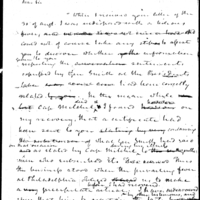
Despite being afflicted with a vicious fever, McHenry has attempted to ascertain whether the sentiments attributed to General Smith have been correctly stated. Before he died, Captain Mitchell had presented his version of General Smith's conversation as had Mr. Bayard of the house of representatives of Wilmington, Delaware.
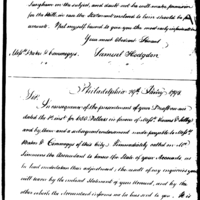
Received in to the public store from Jacob Anthony to Samuel Hodgdon $114 for 2 bassoons and 4 clarinets. Hodgdon indicates he inspected instruments at the request of General Wilkinson and Quartermaster General.
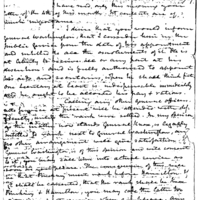
Among other matters, Hamilton decries the decision to waive emoluments for general officers until called into active service and hopes the President will change his mind and take advantage of this important resource.
Firmly insists upon the order of rank for Major General of the Provisional Army to be Knox, Pinckney, and Hamilton, in accordance to their experience. Expresses deep respect for Washington, but states that the power and authority are in the President and reminds McHenry that he is the President.
Adams states that he cannot share McHenry's stated sentiments on relative rank to General Knox, as he cannot agree with them. Affirms his belief that the law dictates that rank between officers commissioned on the same day should be determined based on prior service. Says that he made the nominations based on the list Washington sent him, and had hoped that rank would be worked out between the men. Did not believe the possibility of Hamilton's outranking any other major general was even an issue. Says he is willing to write Knox's commission on the first day, Pinckney's on the second, and Hamilton's on the third; if, otherwise, all commissions are written the same day, he says Hamilton will be outranked by the others, as well as by [Edward] Hand and [Henry] Lee [III]. Says that he [Adams] has never settled an issue of rank, and would gladly leave it and the office of president to Washington, but will not allow the president's responsibility be executed by someone [i.e. Washington] who is not holding the office. Says that the responsibility is, and must be his; disdains the amount of intrigue which has resulted from this issue, and reaffirms his opinion that the relative rank should be Knox, Pinckney, Hamilton. Extends sympathies for the ill health of McHenry and his family; notes Mrs. Adams' extreme sickness as well.
Hodgdon discusses at length proposals for the location of the third arsenal and magazine which will be added to the ones already at Springfield and Potomac.
Along with supply concerns, Hodgdon notes that Philadelphia is nearly depopulated due to fears of the fever that has infested it. The health of the Secretary of War does seem to be improving.
Certification that $562.88 is due a detachment of recruits under the command of Capt. Edward Miller, being the pay of Ensign Joel Cook and the non-commissioned officers and privates through July 1798.
Discusses the fort at Castle Island [Massachusetts], and the relative suitability of various officers. The latter largely concerns the abilities of a Major Brooks to one of the new regiments. Discusses various officers for the corps of artillerists & engineers, noting the problems which arise when an army is expanded quickly, and normal lines of promotion are thrown off track.