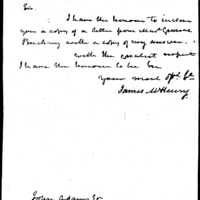
McHenry requested approval of Hamilton on the selection of several men who applied for military service/appointments. McHenry previously sent list of men to all Major Generals for their knowledge on the men and their thoughts on the appointments. Comments on McHenry's letter to the Generals included.
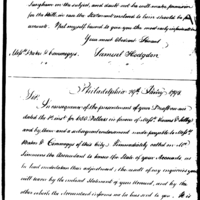
Francis requests drawing paper and cartridge paper be sent to the military store for the Mississippi. The document is annotated with a note from Samuel Hodgdon.
Francis is directed by the Secretary of War to purchase and place in the public military store a number of articles for the use of the following: carpenters, coopers, blacksmiths, armorers, wheelwrights.
Outlines possible officers to file the command and positions on the Corps of Artillerists and Engineers. Makes note of desirable characteristics of commanding officers.
McHenry informs the head of the Baltimore Naval Committee that he is sending the $4,000 and copy of Major Tousard's estimate for the Fort McHenry defenses, as requested; says he will write again concerning the remittance of the balance of the original $20,000 to the committee.
Among other topics, McHenry consults with the president regarding how to resolve the controversy as to who is the most senior general, Hamilton or Knox.
Encloses commission as Major General in the US army and requests presence at Trenton or Philadelphia for advice and assistance with Knox and Washington. Plans to raise an army to submit to the President. Considers nomination and support from the Senate.
Acknowledges receipt of commission as inspector and major general; states that he will defer his journey until late October, so as to arrive [presumably at Philadelphia] around November 1. Observes with satisfaction the relative rank of the major generals, and promises to send a response to an inquiry of McHenry's after consultation with other officers.
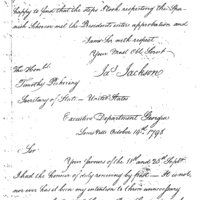
Jackson objects to the President's calling into service the Militia of Georgia because such an action would leave that State and its citizens unnecessarily vulnerable to invasion. Since ordering northern troops into Georgia would expose them to unhealthy conditions, it seems reasonable to man the State's garrisons with local militia rather than having them sent to posts outside the State.
Pinckney states that he learned of his appointment as major general via a newspaper while en route from France to America; asks that McHenry inform Adams that he will accept the commission. Requests permission to see his wife and daughter to Carolina before returning northward, and also requests a commission for his former secretary, who has spent time studying military books and observing foreign troops in Europe. Recommends him on several counts.
Encloses Pinckney's commission of Major General of the Provisional Army and reaffirms the relative rank of the Major Generals despite the surrounding controversy: Hamilton, Pinckney, Knox.
Wolcott expresses concern for promised Charlesville-pattern muskets. Refers to previous correspondence with Mchenry and with George Fleming, storekeeper at West Point. Fleming was disappointed in the inability to provide the right pattern, but believed that in 1793, 2000 patterns existed in Albany and 5000 at Springfield. Refers to correspondence with John Harris in Philadelphia and John Dexter in Rhode Island about musket patterns, sending others to Baltimore. Contractors depend on the public store for their supplies. It is Hodgdon's duty to provide supplies as promised.