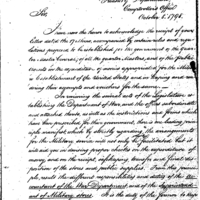
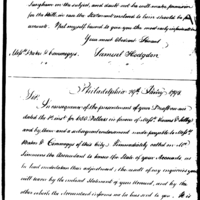
Submits to Simmons a copy of Wilson's deposition before John Gibson, and letter from Edward Day, late Deputy Commissary to U.S. Army, both relating to accounts of James O'Hara, contractor for supplying army with provisions. Encloses copy of letter to O'Hara.
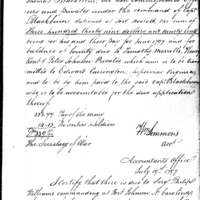
Simmons is requested to debit in the books of his office $361,239 from James O'Hara's account as contractor by making such entries for that purpose as the nature of the case may require.
Hodgdon attributes the delay in Kilty's order either to the ineptitude of the proprietors or the rascality of the drivers but hopes that it will soon be delivered.
Hodgdon recommends transporting the powder from Charleston in casks made specifically for that purpose rather than in the boxes in which it currently resides.
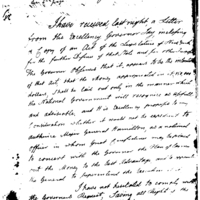
Adams informs Hamilton of the plan of execution for the arrangements being made for defenses at New York City, and that he has been placed in charge of that execution based on the confidence of the New York legislature and Governor Jay. He quotes the relevant portions of the legislature's act.
The legislature of New York has appropriated $150,000 to provide for the defense of that state and Hamilton is asked to work with Governor Jay in laying out and executing an effective plan to that purpose.
Adams accepts the plan of Governor Jay and the New York legislature to place the funds and execution of the preparations for the defense of New York City in the hands of General Hamilton. Does so on the condition that no part of this "act of the Executive authority" shall be understood to have any inference which may at one time come under the scrutiny of the legislature of the United States.
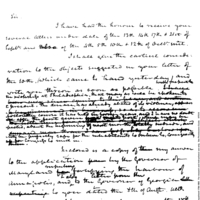
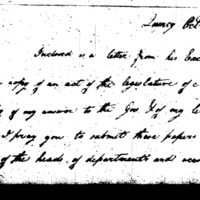
Submits copies of letters to and from Governor Jay of New York, an act of that state's legislature, and a letter to Alexander Hamilton; asks that McHenry distribute these to all the Cabinet officials and have them decide whether Adams' actions have been correct.