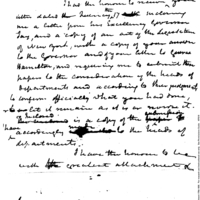
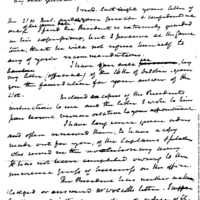
Acknowledges receipt of letter and copies of correspondence with Governor Jay and General Hamilton, with a copy of an act of legislation from New York.
Fleming is forwarding to the Secretary of War a sketch of the rebuilt north wall of the powder magazine in old Fort Clinton. After having viewed the side wall taken down and the ends of the timber of the bomb proof, he believes that with some small repairs, it should last 12 or 15 more years. It would be expensive to build a new magazine of masonry large enough to contain the amount of powder now contained in this restored magazine.
Craig has authority from the Quartermaster General to direct Hodgdon to send forward the articles enumerated in General Wilkinson's requisition. The QMG expects to set out for the seat of government in a few days and will probably see Hodgdon at that time. Craig notes that his coffee is nearly expended so Hodgdon should procure same and send it along.
Muster and pay rolls enclosed. Receipts of Luther Russell and Thomas Hughes (the hired blacksmith) included. Inlistments recorded by Drury, Smith, Sherer, Patterson, Johnson, and Conway, along with receipts for bounty money enclosed.
Regarding the draft, Barclay neglected to have it endorsed by Alexander McLaughlin. Annexed is note to Secretary of War. Hope that this will enable Klaus Graff and Company to draw money.
In addition to his continued concern about the disease afflicting Philadelphia, Hodgdon expresses relief that the Federalists have done well in the recent election and will have a strong presence in the next Congress.
Hodgdon compliments Smith for the promptness with which he has executived certaincommissions and urges that a pattern sword be sent to Hartford for the use of contractors Greenleaf & Briel.
McHenry begins a discussion of Adams' handling of the plan proposed by New York for the development of its own defenses, with Alexander Hamilton in command of its execution. Adams has asked the department heads [Cabinet] to review his actions in the matter, and see if it is necessary to reverse them. He then quotes extracts of all the relevant correspondence [which are also listed separately by their dates in this collection]. At [Image 14], McHenry presents his own opinions, considering laws which empower the president to authorize [money for?] defensive preparations by the states [without the prior approval of Congress?]. He appears to come out in favor of the president's authorization for New York to "go ahead," though warning that close observation should be leveled on the New Yorkers now spending the government's money.
Admits the President is extremely guarded in his opinions. Encloses copies of the President's instructions and information about service in the Revolutionary army. No word from General Pinckney on Hamilton's commission.
According to the an opinion of the Attorney General, Lt. Campbell Smith is entitled to all the emoluments attached to the office of Judge Advocate only for such time as he was actually employed by Brig. General Wilkinson or by orders of the Secretary of War since April 30th last in that capacity.
Speech, by Ducayne, discusses murder & horse theft; discusses White encroachment; alludes to Indian retaliation. Document also contains Capt. Pasteurs reply to Jean Baptist Ducayne.
Simmons should examine his files regarding expenses for officers who have served on courts martial as members, witnesses, etc. so as to ascertain the appropriate per diem expense allowances for these officers.
President authorized the use of money for repair and improvements to forts in New York and appointed Hamilton to superintend the execution of it. Jay requested all information required to commence repairs be gathered and given to President before next session of New York Legislature.
Mr. Nicholson informed Miles that he believed Hodgdon would pay the enclosed bill. If so he wishes to be sent a receipt for it that he may sign off on, as he finds it inconvenient to have to come into Trenton for this.