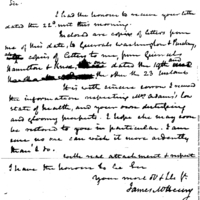
Informs Washington that Adams cannot leave his wife's sickbed until it is absolutely necessary for him to meet Congress, and that he has authorized McHenry and the generals to decide the appointments of field officers in the provisional army; McHenry is calling upon the generals to meet. Says he expects Pinckney and Hamilton to be present on November 10, while Knox has refused his commission; asks that Washington attend as well, with all papers pertaining to officer candidates from the Southern Department.
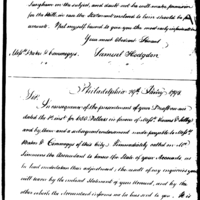
Informs Pinckney that he has written to Hamilton & Knox, calling them into service at Philadelphia, and hopes that Washington will attend as well. He writes that Knox has refused his commission on account of being ranked third among the three major generals; that Hamilton will arrive as requested; and that Washington will meet once all have assembled, but will remain at Mount Vernon until that time. Explains why he is calling the generals together: 1) to make use of their experience in deciding upon the many applications for officers' appointments which have been received by the War Office; 2) to discuss the disposition of troops; 3) to discuss the provisioning of troops; 4) to discuss the necessary level of military stores. Says he hopes that Pinckney will be able to attend as Hamilton and Washington have expressed their willingness to do so.
McHenry forwards his recent correspondence with Generals Washington, Hamilton, and Pinckney, as well as that with Henry Knox. Wishes better health and spirits to Mr. and Mrs. Adams.
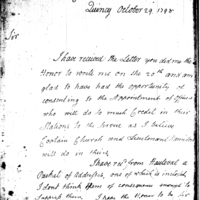
Adams has consented to the appointment of Captain Church and Lieutenant Hamilton as officers. He has also received from Lucien Hauteval a packet of addresses which do not seem to be of sufficient consequence to suppress.
Ill health in family has kept Washington from answering letter. He planned to travel to Trenton to visit the Secretary and assist in any way possible. Noted, "the War Department cannot prosper in the present very well disposed but very unqualified hands.
P.S. General Pinckney satisfied with military arrangements.
In a typically inscrutable Sargent missive, the following are the legible portions: two fashionable [?]; Mrs. Sargent; young lady; whole length of tape or measure; her daughter, Miss Mary Williams; lace; transportation-land or water; twenty or thirty pounds;
Hodgdon expresses the uneasiness of the Secretary of War regarding the clothing intended for the northern posts which must be forwarded before winter arrives.
Langham wishes for Hodgdon and the Secretary of War to attend to my Western arrangements as this has gone undone for a significant amount of time. Langham is heading out into the country for the winter (apparently for private business) and will return in the spring. In the meantime, Colonel John Morrow will be in command. Langham states that the establishment at Harpers Ferry seems to be prospering and that he would like to remain as superintendent after the plan is ready for completion of public stores. Langham has no objection to quitting his western pursuits, but until then he must continue his pursuit of private business out of necessity, though ensuring the public business is not neglected. Langham has made this known to the Secretary of War.
Osborn has been charged with mistakes on his provision returns for June and September. The former was made by the contractor and the one for September is in error since Osborn has not drawn rations since August which will be verified by examining the accounts of Mr. Meminger, the contractor.
Notification to Simmons that he has paid William Crafts, Agent of the Fortifications at Charleston, South Carolina, $3463.45, money to be paid to Thomas Bennett per his contract for erecting an extension of Fort Pinckney
Reply to Simmons' questions regarding monies received by Ewing in 1794 for Captain Seeley Fithian's company. Provides fcopies of two receipts concerning transactions of the company monies.
Certification of payments; $41.85 pay to Issac Spafford, late a Private in Lieutenant Nanning Vischers detachment of Artillerists and Engineers at Oswego, New York.
The officers and witnesses who attended the late military courts held at Trenton, New Jersey are to be allowed expenses for their board and lodging and travel expenses travelling to and from Trenton. The gentlemen who acted as Judge Advocates are also entitled to similar allowances.
McHenry submits a copy of his circular to the heads of departments, which he prepared as per Adams' request that they adjudicate the rightness of his decision(s) regarding the New York Defense Plan.