General Matthews has been ordered to inspect the recruits that have been enlisted by Lt. John Hancock at Kempsville, Virginia.
Major William Alexander is ordered to muster and inspect the recruits enlisted by Capt. Callendar Irvine at Carlisle.
Reports exchange of $1000. Encloses regulations about fuel for the garrisons on the coast, with the request of certain articles, clothing, boots, and supplies. Plans to send someone to Vermont.
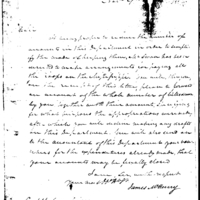
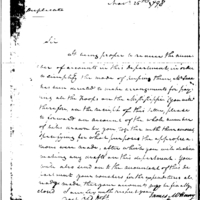
McHenry mentions that the War Dept. is simplifying accounts. Thus Caleb Swan is being assigned to the payment of all troops on the Mississippi; Guion is to provide a full account of bills drawn, together with their purposes, and desist making any more drafts upon the War Department.
Jay agrees with Hamilton that engineers should be involved in the fortifications project. He notes also that the appropriations have been provided by the national government so the project must proceed under the direction of the President of the United States.
Jay never received letter from Hamilton regarding the employment of engineers for the design of fortifications for New York Harbor. Nevertheless, Jay felt they should readily be employed on the task and authorized Hamilton to seek out the men, offering to pay for all expenses.
Cushing provides his assessment of the current state of arms, clothing, and accoutrments. Though his knowledge of the cavalry is limited, he believes their clothing is generally as defective as that of the other corps.
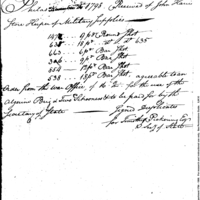
Acknowledges receipt of round shot and bar shot for six pounders, nine pounders, twelve pounders, and eighteen pounders, agreeable to an order from the War Office, for the use of the Algerian brig and two schooners, to be paid for by the Secretary of State.
Encloses proposal by Col. Hawkins to establish a silversmith at the post. Reports process of building his own accommodations. Refers to case of insubordination and frays between Indians and soldiers. Includes list of people licensed to trade in the Creek Nation.
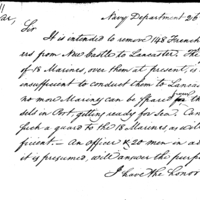
Writing from the Navy Department, Benjamin Stoddert informs McHenry that he intends to move 148 French prisoners from New Castle to Lancaster. He asks for more men to augment the 18 Marines as they transfer the prisoners. Asks for an officer and 20 men.
Jackson discusses the case of Lieutenant Cobb who, because of a derangement of the Army, lost two year's opportunity to rise in rank. He has been reinstated in the Artillery but now finds himself in the position of having to obey those he once commanded. He and his family are honest and respectble and zealous friends of the federal government. Jackson requests that Cobb be given command of one of the companies to be raised.
Enclosed an abstract of articles purchased by E. Stevens, agent at New York, Hodgdon notified Simmons he would make the appropriate entries in his books and hold Stevens accountable for the expenses.
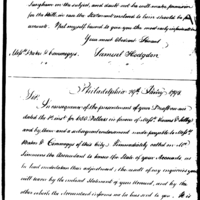
Hamilton, Washington, and Pickney in Philadelphia to raise enlarged army. Hodgdon advised Van Rensselaer to make claim to men if he believes he has rights to command.
Hodgdon believes that in times of peace small repairs to musketry at posts contiguous to cities should be made by private workmen. The wear on the muskets and cost of transportation to military repairmen would be greater than if the repairs were done privately.
After giving his opinion as to the kinds of field pieces that should be provided to the State of New Jersey, Hodgdon states his belief that iron field pieces are as effective as brass field pieces even though they cost much less.
Hodgdon has received the abstract of articles purchased by Ebenezer Stevens as Agent for the War Department in New York, for which he is held accountable.
McHenry mentions that the War Dpt. is simplifying accounts. Thus a Lt. Swan is being assigned to the payment of all troops on the Mississippi; Guion is to provide a full account of bills drawn, together with their purposes, and desist making any more drafts upon the War Department.