McHenry speculates on the whereabouts of the President and wonders whether or not the Republican militia paraded since they dislike the President. Did the blues parade? Did the new army parade? The Congress has ordered it do so without consulting the President.
McHenry requested Washington's advice on when to appoint officers and staff regiments of provisional army if law regarding armed forces passes in Congress.
The bearer William Cuming has a large family with seven or eight children. He has no business and wants to be employed in the public service. Steele hopes that Cuming's conduct will inspire Hodgdon's confidence.
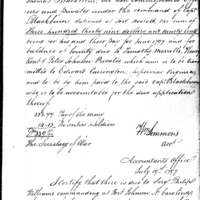
Bryant apologizes for the mistakes in his returns in which some articles are missing. He has a great many returns and many other papers to examine. Colonel Williams will soon help him examine his returns but he is certain that no articles have been taken out of the stores without a proper order.
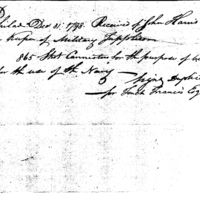
Starr received $2000 from accountant of War Department by hands of Chauncey Whittlesey for manufacture and delivery of 2000 cavalry swords with scabbards and belts complete.
It is not proper to remit the small sum requested because no one is authorized to sign the receipt, unless he has a friend there who can sign. In that case, the money will be paid to his order. If no one else volunteers, the assigned member of Congress from his district can sign the receipt and pick up the money. At any rate, Hodgdon will pay the money as soon as he can get a receipt.
Certification of payments; $422.38 balance of rations and forage Corps of Philadelphia militia infantry under command of Colonel William Macpherson, called into service to suppress an insurrection in the Western Counties Pennsylvania, in 1794
It is recognized that the expenses entailed in the pursuit of Mr. [Griffith] McKee's duties, including the employment of special messengers to convey his corrspondence, the need for quarters at the various places he was required to visit, and horses he had to hire, should be born by the United States.
Craig has purchased at a public auction of the Commissioners of Pennsylvania two lots at LeBeouf which he considers necessary for the United States to possess since they adjoin the grounds on which the public buildings are erected. He presumes that McHenry has made the proper application to the legislature of Pennsylvania who can be expeted to cede the property to the United States.