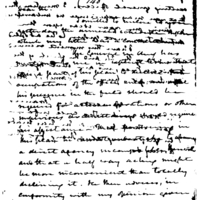
Gunn encloses a copy of the military bill reported to the Senate and asks Hamilton for amendments. He believes that every state should provide one regiment to the [Eventual] Army and that the endless debates in the House of Representatives only aid the enemy.
MacKay laments the absense of his name from the lists of military appointments, probably due to his birth in a foreign country. He wants Hamilton to know that he is still available for service.
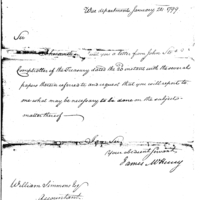
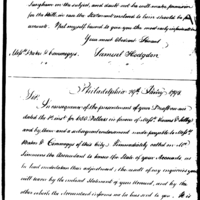
Refers to Caleb Swan Paymaster of troops letter. Says that the accountant of the War Department was long since furnished with with copies of instructions and forms forwarded to the paymaster of troops.
Steele points out the diifficulties and inconveniences caused by Paymaster Caleb Swan's rigid adherence to the instructions and forms currently being required of those in the public service.
Strong chronicles the ongoing disputes betwen the residents and the soldiery on the northwestern frontier and asks McHenry to clarify the principles upon which he must act to resolve these disputes.
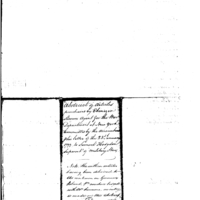
Includes abstract of supplies purchased by Ebenezer Stevens for the War Department with approval by the superintendent and the master mason. Considers Stevens completely exonerated and no longer accountable for this expenditure.
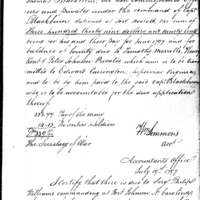
Has examined the accounts of cash transactions. Includes money to make up the difference and to pay transportation costs. Hopes to resolve difference of lost money. Wants to know how to account for money from Mr. Perkins with his certificate. Mr. Ball's account has been paid to Andrew Brown's newspaper.
Sends requested clothing and military stores. Because the waterway is unsure, will send by wagon. Requests acknowledgment of receipt and whether the shipment agrees with the invoice.
Certification of payments; $621.41 to detachment 1st Regiment Artillerists and Engineers stationed at Mud Island Fort under command of Captain Joseph Elliott.
Abstract of articles purchased by Ebenezer Stevens, agent for the War Department at New York. Articles delivered to the workmen on Governor's Island New York include anchors, lime, planks, boards
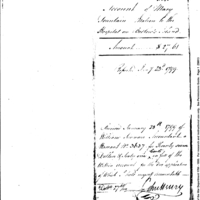
Payment of $27.61 to Mary Fountain, matron to the hospital at Bedlows Island. Her services attending the sick are certified by Samuel Osborn and Captain John Henry of 2d Regiment Artillerists and Engineers.
Announces that he will soon enclose an abstract of the articles purchased by Colonel Ebenezer Stevens - Agent for the War Department at New York - for delivery to the fortifications at Governor's Island.
The Jollys offer to respond to Hodgdon's order and deliver iron of the best quality and of all descriptions. They have been supplying Mr. Francis for some time and he will concur that they supply iron of he best quality. They did not supply Mr. Mackie with the rolls that he described as so bad that they could not be used.
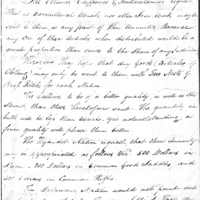
Ottawas, Chippewas, and Pottawatomies request that instead of farm tools, dry goods (articles of clothing), be sent as their annuities because iron tools could not be distributed evenly among the members due to its worth. Requests from other tribes detailed as well, such as brass kettles. Calicoes of better quality, as well as shrouds. Quantity in bulk will be less than usual, but finer quality will please them better. Wyandot Nation request that their annuity be $500 in specie; $200 in common good saddles; $300 in common rifles. Delaware Nation would not point out the particular articles, therefore thinks that the same assortment received last year, calicoes excepted. Wabash Indians promised to send articles they required. One piece of fine 2d broad cloth for the use of the chiefs of each nation is necessary.
Examination of vouchers for firewood for Col. Stevens's troops on Governor's Island reveals a question about the amount received. Requests the opinion of the accountant, who will most likely need to communicate with the Quartermaster General. The money drawn by Col. Stevens does not go through the Quartermaster General, and the account should be settled by the accountant.
Encloses schedule that was forgotten in the previous post. Mentions plans of officers to decline nominations until actual operations are necessary in order to maintain occupations. Claims that this is more damage than good.
McHenry discusses General Washington's wishes to be excluded from anything other than actual field operations. The General also wants to divide the military command between the existing general officers.
Stevens advises Hodgdon that of the three mehods of compensation--salary, commission per centum, or commission per disbursement--he prefers a commission for buying and superintending all military matters.